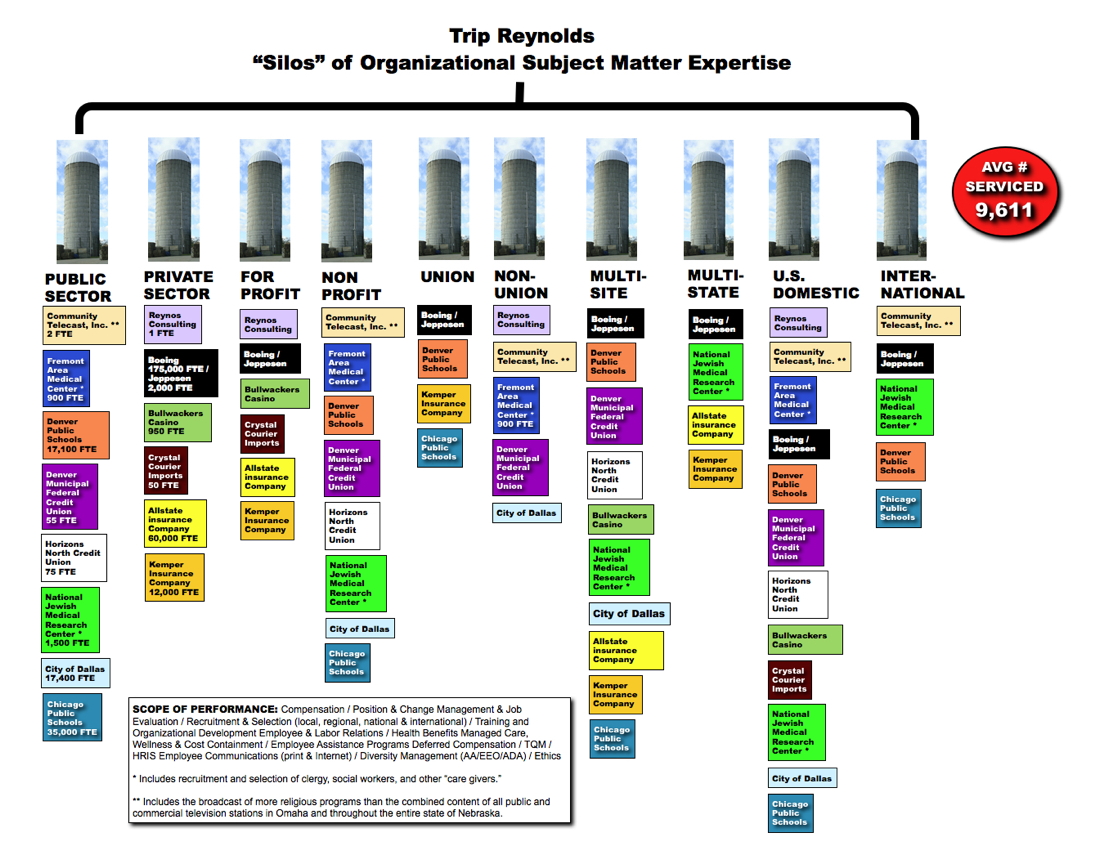
Work History
Demographics: Diverse work experience in public
education, finance, health care, municipal government,
property/casualty insurance and part-time human resource
consulting in the finance, gaming, IT, retail, and
manufacturing industries.
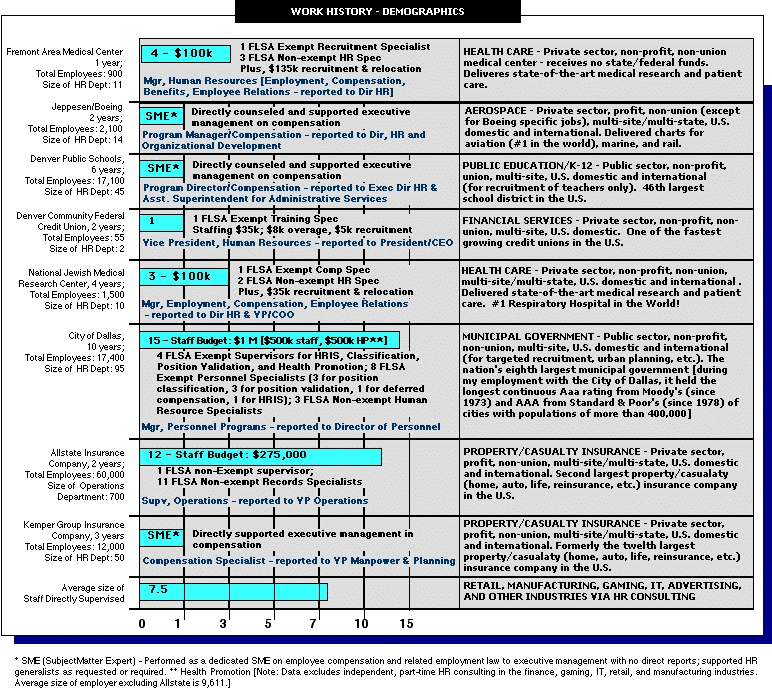
Technical Skills
Self-assessment: I make a point of keeping my
technical skills as good or better than those of my staff
and peers. I maintain an awareness of the evolution of
comp and benefit practices, employment law, and computer
software, hardware and peripherals. For example, web site
design was not my responsibility for my previous
employer. However, I volunteered to design the HR
department's web site because of the critical need to
communicate HR services, and because no other HR staff or
management employee had this knowledge. For my own
benefit, I trained myself on HTML, and I've been managing
web sites for many years.
|
Reporting
Relationships: My primary
audience for the delivery of human resources has
consistently been the highest level executive responsible
for HR, an EVP/COO, or President/CEO, or Boards of
Directors (including City Council, County Commissioners, Chambers of Commerce, etc.).
Profile-Work
Environment
Management/supervisory:
Thirty years of successful experience hiring, training,
developing, compensating, disciplining, and rewarding a
quality staff of FLSA exempt and non-exempt human
resource professionals.
• Reynolds promoted 60% of
all employees who immediately reported to him.
• As a result of effective recruitment and professional development, Reynolds never
terminated any of his reports for cause.
Trip is not
only a friend, but also my mentor and former manager.
He is able to adapt and use his expertise in any
industry. As a HR Manager, I have worked primarily in
the manufacturing and food industry since 1995. I have
requested Trip's HR expertise many times and he
successfully helped me through many HR situations
ranging from employee relations, compensation and
training. He has also helped me in starting my own
consulting career. I recommend Trip Reynolds to any
employer that is looking for a seasoned, proactive and
innovative person. You would not be disappointed.
Elizabeth "Liz" Laurel, Human Resources Manager,
Pacific PreCut
|
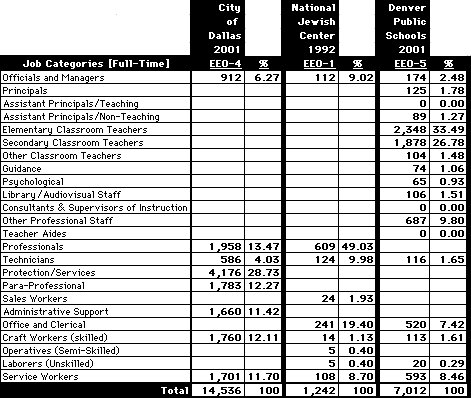
As demonstrated by
the exhibit at right, which compares the EEO-1, EEO-4 and
EEO-5 of three-(3) of my previous public sector employers, I have a
demonstrated history of interacting with a functionally
diverse framework of senior executives (on average, 17.77%
of my "primary customers" has been senior executive management), which includes hundreds of presentations and/or public speaking on all HR and other issues before senior executives, 501 (c)(3) boards of directors, K-12 Boards of Education, City Councils, criminal courts, civil courts, unemployment hearings, worker compensation hearings, public television, grade schools, high schools, civic organizations, and community groups, and numerous employee-oriented encounters which are typically on-demand, unplanned, unscheduled and one-on-one or one vs. many.
As organizational structures change due to diverse
business pressures, market conditions, changes in
technology, cultural diversity, RIFs, etc., I'm empowered
to succeed due to my success working within many
culturally, ethnically, and vocationally diverse
environments.
Performance
Self-assessment: I am not a negative person. I act
positively about meeting my challenges head-on (leading
the research and preparing an action plan) and achieving
success. If unsuccessful, then I review and evaluate the
process. I don't point fingers! I'm very creative in my
problem-solving efforts, which includes looking for ways
to save money and realize efficiencies with or without
"recreating the wheel." If I have any say-so in the
matter, I will consistently but diplomatically push to
make things better for my employer!
|
|
A leader knows the way, goes the way, and shows the way.
Leadership is an action, not a position.
Vusi Kunene as "Modise" in the 2025 film, "Sniper: The Last Stand"
As a senior leader in human resources, I've been immediately responsible for
directing and administering policies and procedures
relating to all aspect of the Human Resource Department's
programs and activities. The full scope of work involves developing and/or
coordinating programs and policies in recruitment, selection, position
classification, compensation, employee relations,
employee benefits, retirement plans, and training, and in concert with an emphasis on internal human capital performance and external customer and client service delivery.
Presented below are statements that specifically address
my skills, knowledge, abilities and experience in
successful performance and management of the
aforementioned posted position
responsibilities. For "team building" in employee-based athletics, click here.
Examples of the Character and Scope of Management Challenges and Positive Outcomes Achieved:
• What is my management style?
• How do I resolve supervisory challenges with positive outcomes?
• How do I successfully establish credibility within the organization?
• How do I effectively work "across boundaries" within the organization?
• How do I successfully work with different styles of management?
• What is my "Customer Service" approach to my management style?
"Thank you
very much for taking such an active, enthusiastic role
in the four safety seminars provided for office
personnel from the Business Operations of Dallas Water
Utilities last week. Seventy-eight (78) employees
attended the seminars, and I've heard some wonderful
comments and compliments. We look forward to working
with you again."
Janet Milligan, Prebill Audit and Clerical Support
Supervisor, Meter Activities Division, City of
Dallas
Skill at working in
rapidly changing environment and prioritizing assignments
with competing and constantly changing priorities:
The nature of my work REQUIRES it, and I'm accustomed to
simultaneously handling multiple projects (often
controversial and/or of great complexity) with
conflicting deadlines. For example, changing a salary
range typically has a domino impact on recruitment,
benefits, merit budget, and potentially, might produce
pay inequities (race, sex, etc.), and possibly, EEO
claims, and I've always handled these events
concurrently, and successfully!
"Trip has
demonstrated a thorough knowledge in the human
resources field. His ability to deal with the issues
is reflected in how he has handled difficult
situations for the Plant Services Department. He is
able to support the employee's position and maintain a
strong representation of this institution's policies
and goals."
Rich Palestro, Director of Plant Services, National
Jewish Center for Immunology and Respiratory
Medicine
|
| |
Q & A: What is my management style? |
Bottom line, I focus on employee and organizational performance, not behavior. As validated by volumes of case law, and the “at-will” doctrine, an “employee” is not under any obligation to “like” their boss or employer, or to “feel” good about any aspect of their employment. Likewise, the employer is not under any obligation to “like” its employees, or to provide health benefits, fitness facilities, transportation services, etc. The “work” is performed within the context of an “adult-to-adult” professional relationship, not “parent-to-child” or “husband-to-wife” or “best friends” or any such affirmation. Although a “positive and productive work environment” can be emotionally satisfying for many employees, the “character and scope” of the work environment is not emotionally-based, but strategically designed (sometimes with air conditioning, van pool services, valet service, wellness facility, daycare, cleaning services, etc.) to maximize employee productivity for the production of products and/or for the effective delivery of services to clients and customers.
However, in contrast to the aforementioned, my management style is not stoic, and I consistently encourage all management and staff to enjoy their jobs, to recommend improvements when appropriate, and to have fun in the performance of their essential job functions - while being compliant with employer policies, procedures, and employment law. It's my practice to guide and counsel senior management and staff in the aforementioned, because failure to focus on the strategic performance of business unit objectives typically results in "individual" and/or "organizational" complaints (i.e., Title VII, ADEA, AA/EEO, etc.) in one or more of the following three-(3) areas:
a. Compensation and Benefits – perception of being under-compensated; increase in the cost of health care and/or reduction in health care services; pension and deferred compensation;
b. Employee / Labor Relations – perception of inequitable treatment; tenure; employment status; discipline; sexual harassment or abuse; discriminatory practices; or inequitable compensation;
c. Negligent Management – Poor leadership; discriminatory practices; incompetence; lack of job knowledge;
|
|
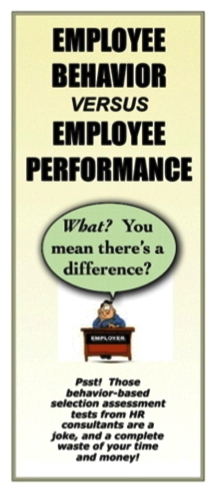 |
Again, I focus on employee and organizational performance, not behavior. My management style is equally candid and positive, and extremes in performance are counterproductive to the achievement of strategic business unit objectives:
• Employees are not compensated to “feel,” or to be “emotional,” or to be overtly “altruistic” at the employer’s expense, or to be “narcissistic” for their own betterment.

• Employees do not come to work to “feel” good, but to be compensated in return for work “performed,” because in the absence of compensation, employees would not report to work.
"Trip has demonstrated a thorough knowledge in the human resources field. His ability to deal with the issues is reflected in how he has handled difficult situations for the Plant Services Department. He is able to support the employee's position and maintain a strong representation of this institution's policies and goals." Rich Palestro, Director of Plant Services, National Jewish Center for Immunology and Respiratory Medicine
|
| |
Q & A: How did I resolve past supervisory challenges with positive outcomes? |
Please see "Scope of Candidacy"
for a general overview of my supervisory experience
with staff, and to discover the character of positions
that reported to me.
• Promoted 60%
of all employees who immediately reported to
me.
• Have never
terminated any of my reports for cause.
A. Specific
challenge (What was changing): In 2021, a Reynos.com client was experiencing disciplinary problems with ten-(10) employees working for a non-union manufacturing company with a total employee population of only fifty-seven-(57) employees; and the absence of discipline, including job standards and clearly defined management hierarchy, revenue streams were declining and customer and vendor relationships were routinely compromised.
Outcome
(What did I deliver): I wrote an Employee Handbook which detailed employer policies and procedures, including progressive discipline and all related management hierarchy; created and/or updated all job descriptions; wrote job standards that reconciled with all essential job functions AND the employer's strategic business unit objectives; implemented the aforemention via on-site employee meetings and related training seminars; placed one-(1) employee on progressive discipline for failure-to-perform and provided additional training that enabled employee to eventually and consistently meet all performance standards; terminated one-(1) employee for failure-to-perform. Revenue streams increased to record highs and all employee disciplinary problems were eliminated.
B. Specific
challenge (What was changing): In the mid-1990s
at National Jewish Center, with the recent passage
(July 26, 1992) of the Americans with Disabilities
Act, various civil and human rights groups elected to
use the Center as a testing ground [Translation:
Media Event] for this law, specifically, gaining
access to medial facilities who (they knew) had not
yet had time to make their facilities accessible to
disabled applicants and/or employees through various
accommodations, such as converting or expanding
doorways, hallways, and ramps to make them more
accessible. In particular, the human resource
department was located in the worst possible location:
a freestanding building (which was originally a large
one (1) family residence) that was ONLY accessible to
persons who could walk (there were no ramps), and the
building had extremely narrow hallways.
Outcome
(What did I deliver): I coordinated efforts of
my staff located at the Center's main lobby and
staff based at the HR department to (1) take a
vigilant and positive approach: If ADA applicants
can't get to us because of our brick and mortar
limitations, then we must go to them. Consequently,
to accommodate ADA applicants who entered the
Center's main lobby, and to mitigate the
possibility of staged media events, we (my staff
and others) used vacant offices and conference
rooms adjacent to the main lobby that were ADA
accessible. We were very successful.
C. Specific
challenge (What was changing): In the late 1980s, at the City of
Dallas, in an effort to attract more business, the
Department of Convention and Event services sought the
creation of a new class of (Trade Show) electrician
[staffed primarily by card-carrying, free-lance
IBEW members] with a higher salary range than
regular full-time electricians. Notably, the HR
department (specifically, me and my immediate staff)
did not support the creation of the Trade Show
Electricians, and advised against doing so in writing.
However, internal politics overrode our counsel to
avoid a likely employee grievance or class action.
Ultimately, regular full-time electricians perceived
the creation of the Trade Show Electrician as a salary
inequity and, as expected, they pursued both grievance
and class action.
Outcome
(What did I deliver): I directed my staff
[one (1) FLSA exempt supervisor and three (3)
FLSA exempt position classification analysts]
to conduct job audits with rank and file regular
full-time electricians and all other positions that
perform similarly classified work (32 position
classifications), and to conduct employee meetings
with grieving employees. The result: As we had
originally advised, we eliminated the perception of
inequity by consolidating 32 positions
classifications into 11 classifications of two
groups, one for electricians, and the other for
electronic technicians, and we eliminated the Trade
Show Electrician position classification.
D. Specific
challenge (What was changing): In the early 1980s
at Allstate Insurance Company (9,000 employees;
Irving, Texas zone office; 60,000 employee worldwide),
all manually retained customer files (approximately 1
million) were scheduled for conversion to optical. As
the Operations Supervisor immediately responsible for
a records area staff of eleven, I was directed to
transition all of my staff into new or existing
positions in other departments within 30 days.
Outcome
(What did I deliver): I transitioned all of my
staff to new or existing positions in other
departments within one (1) week! I received
positive recognition from my immediate management
for my zest in completing the project before the
deadline, and for eliminating the need to RIF any
employees. Notably, I am accustomed to completing
my objectives below budget and ahead of
schedule!
|
| |
Q & A: How would
I quickly establish credibility and positively integrate myself
within the organization? |
Action Plan: Look
Before Leaping!
A. After receipt of
written confirmation of employment, and before my first
on-site day of work, I will immediately request delivery
of or access to the following information:
1. A copy of
all position classifications (job descriptions), job
standards, and performance appraisals (and date of
next review) for all employees who will report to
me.
2. A copy of the
current and proposed (if available) budget for my
division of the HR department, including a detail of
all outsourced work, personal services contracts,
vendors, etc.
3. A copy of all
salary schedules, and salary administration policies,
practices and procedures
4. An off-site HRIS
sign-on I.D. (if possible)
5. A copy of the
most recent (if any) needs-assessment [Report
Card] on the operation of the HR
department
6. A copy of all
position classifications for all department directors
and senior staff, including organizational
charts
7. A copy of all
pending ER cases and employee-related litigation
particular to my division of human
resources
8. A copy of the
current and proposed fiscal year objectives for all
departments
9. Answers to the
following questions about health benefits:
a. What are
the employee demographics for each health plan?
[i.e., number of plan participants, number of
women, men, by race, by age, etc.]
b. What are the
top 10 health claim expenses? Are cost containment
controls in place that have restrained or reduced
these expenses? If so, please detail these
controls.
c. When was the
last benefit needs assessment conducted?
10. A scheduled
meeting with the IT director to determine system
strengths, limitations, outlook, etc., and to
determine HRIS capacity
11. After review of
the aforementioned data and communications, schedule a
60 minute meeting with my immediate manager as soon as
possible after my first full week of
employment:
1. To
re-establish and define, if necessary, objectives
and expectations;
2. To propose and
gain approval to measure [i.e., report
cards] all line departments on how well senior
managers and department directors manage their
human resources;
3. To present
and, if possible, acquire approval of my
strategy/philosophy for managing compensation and
for managing position classifications;
4. To present
and, if possible, acquire approval of my
strategy/philosophy for evolving health benefits.
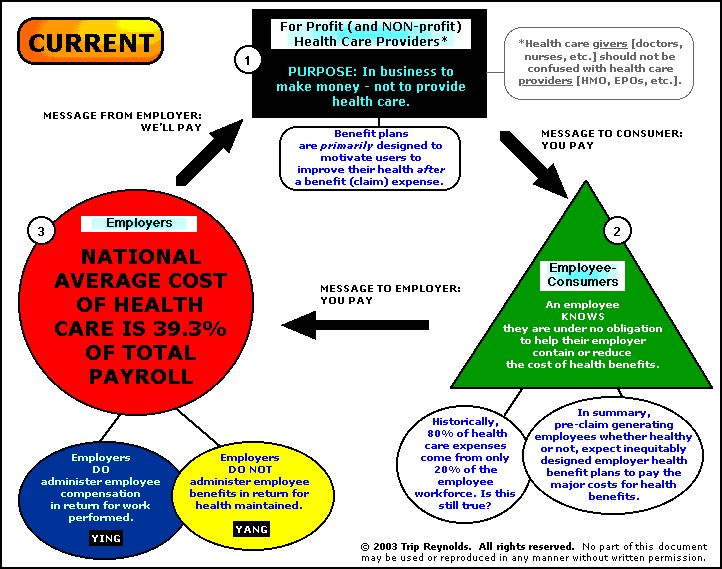
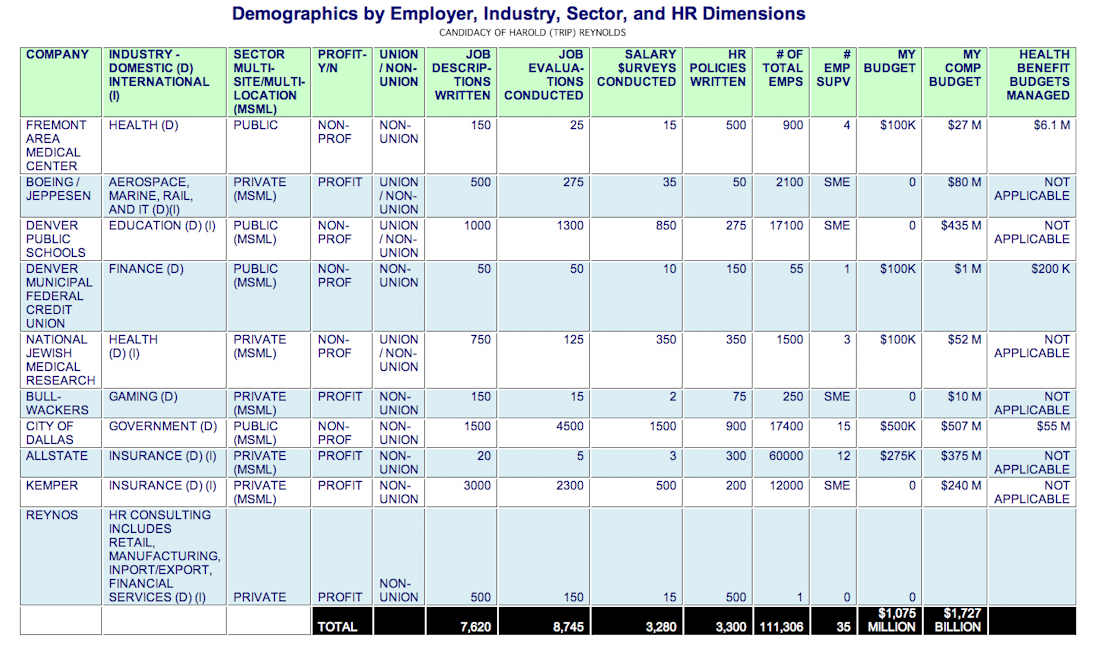
Note:
When provided with an interview, I will freely discuss
the strategy/philosophy behind the above exhibit and a
proprietary proposed exhibit.
B. First day of work:
I'll conduct a 60 to 90 minute all department staff
meeting: to present myself and to detail my management
style; to provide at least an initial 30 minute Q & A
period; to determine the frequency of existing or for
future all department staff meetings; to announce
one-on-one job audits I'll personally conduct during the
first week of my employment (where I will actually
perform some of their essential functions); to discover
the immediate work priorities and concerns of staff and
project timelines to research, analyze, and resolve major
projects; and finally, to inform staff of my practice of
providing to all staff and their immediate family a free
summer and free winter holiday movie [Note: This is
nothing new for me, I've always treated my staff to the
"biggest" blockbuster movie of the summer and winter
because I'm a big film buff!] Purpose: To orient
staff to a objective oriented, very energetic management
style that consistently approaches the work effort with
vitality, fun, and a competitive desire to smartly
produce work of the absolute best quality imaginable, in
the shortest amount of time, with the lowest possible
cost impact.
C. Before the
conclusion of my first week of work I'll have conducted a
60-minute job audit on all positions in the HR
department. Purpose: To acquire an immediate subject
matter knowledge of the key essential functions performed
by staff, and in anticipation of recommendations from
staff on the evolution of their jobs.
D. Before the
conclusion of my first week of work I'll have scheduled
and/or conducted one-on-one meetings will all peer
department directors and their senior staff. Purpose: To
begin the process of evolving human resource operations,
as necessary, in order to convert inefficiencies and
inequities in line operations into efficient or new
revenue streams.
E. At the conclusion of
my first full week of work, I'll provide my immediate
manager with an anal retentive "hit list" of what hasn't
been achieved, what needs to be achieved, and a
measurable and achievable timetable for completing all
objectives. Purpose: To validate planned evolution in job
responsibility, complexity and compensation for my
immediate staff; and through shared measures, to produce
a measured increased in performance for all employees.
|
| |
Q & A: How do I work across
boundaries within the organization? |
Employee
Relations: I've managed the investigation
of numerous employee relations issues (sexual
harassment, racial discrimination, theft, AIDS/HIV,
etc.) between staff and management in different
departments, at all levels, with or without regard
to Title VII or other employment related laws.
Notably, working across boundaries with ER issues
is frequently associated with the greatest amount
of internal politics and, in an attempt to exert
total control over their satellites of power,
senior executives often attempt to prevent, delay,
manipulate, coerce, or force their perceived scope
of ultimate control. Proudly but humbly, I've
consistently been able to wield ultimate success
because, appropriately, I have greater knowledge of
employment laws, case history and practical
experiences in HR that empower me with more
insight, and I perform with reason, not emotion.
Again, it is with good reason that I've never lost
a decision to the EEO, and that I've won 100% of
all unemployment claims resulting from involuntary
terminations I've directly initiated; and I've won
90% of all other unemployment claims!
Training
and Development: Through the existence or
absence of training, line departments will
typically hold a high or low assessment of HR. This
is particularly true of how HR handles the training
and orientation of all staff in regard to:
recruitment processing, HRIS administration, salary
and benefits administration, and payroll. The old
cliché remains true: Never mess with
someone's money! Consequently, HR must ensure the
timely and accurate training of internal and line
department staff responsible for the accurate data
entry of employee information that impacts pay at
any time during the active life of the employee
[hire, active, terminated, retiree]. For
management, staff training in safety and ER issues
also holds high priority.
Position Classification and Compensation: I've
successfully engineered departmental
reorganizations which required measuring and giving
value to positions between similar and dissimilar
departments while carefully avoiding pay
inequities. Unfortunately, I've frequently
corrected the mistakes of HR consultants (Hay,
A.Anderson, etc.) because they typically fail to
measure and anticipate the impact of their
recommendations across boundaries within the
organization. I look before leaping.
HR
Communications: I've communicated human resource and
administrative policies across all boundaries
within the organization via on-site presentations, memorandum, newsletters,
internet/intranet, and to external audiences
as well (candidates, vendors, clients, media
relations, etc.). Plus, I've conducted, assessed, and strategically implemented the results of employee engagement surveys.
Team
Building: As addressed previously, to
achieve employer goals and objectives, working
across boundaries also requires generating
consensus and team building, and to support team building objectives I've implemented industry standards approved by senior management, and the results of employee engagement surveys. I've worked with
hundreds of managers and staff to successfully
achieve consensus (through leading, managing and
participating) in all HR areas for over 27
years!
|
| |
Q & A: How do I adjust to
different styles of management? |
I've worked
successfully with pseudo-paramilitary, male
dominated management who typically populate labor,
skilled trades, public works, IT and senior
management positions; while also working
successfully with a more moderated and nurturing
female dominated management in human services,
health care, and social services. Yet, I've also
successfully worked with non-stereotypical
management styles in complete contrast to the
aforementioned.
I've successfully
worked with "sunset" oriented managers who take a
lethargic approach to problem solving versus
"sunset" oriented managers who "cut corners"
because they just don't care, or to complete that
last big project before heading out to retirement.
I've worked with incumbents relatively new to
management who display similar styles of managerial
gusto, bravado, negligence, insight, and
brilliance.
I've successfully
worked with managers who wear their sex or race or
whatever social or political issue they fancy on
their shoulders. I've worked with management styles
of great insight and keen direction, and in
contrast, I've work with executive managers who
have low self-esteem, chaotic direction, and poor
initiative. I've worked successfully with
the three primary stages of management, ranging from: (1) the ingénue (the new
kid on the block who doesn't have a clue); (2) the seasoned pro (a well-positioned subject matter
expert who knows how and can be expected to get
"it" - whatever "it" is done); and (3) the rank or sage (i.e.,
know it all), who, whether right or wrong, knows
it all.
Most importantly:
1. My "industry" is human resources, and as a consummate HR pro I've successfully supported "subordinate industries" that benefit from expert management of human capital; and
2. Without regard to industry, the "performance" of human capital management is a constant for all HR disciplines, functions, and compliance to employment laws, which are handled, managed, and directed exactly the same! For example, I:
> create and post jobs, and recruit the same;
> conduct job audits and salary surveys and design compensation structures the same;
>
review cases of employee theft, sexual harassment, and racial discrimination the same;
>
handle "relationships" with bargaining units and unions the same;
>
terminate employees for "failure-to-perform" the same; and equally important
>
act in compliance with company policies and compliance with AA, EEO, ADA, ADEA, OSHA, VETS-100 and all employment laws exactly the same.
My subject matter expertise in position management and organizational development is derived from: immediate responsibility for hiring over 50,000 employees; personally conducting over 3,500 job audits; evaluating over 7,000 jobs; writing over 7,200 job descriptions; writing over 3,000 policies; creating over 2,500 salary schedules; writing dozens of employee handbooks; and having reviewed and approved 443,810 employee performance evaluations; but I do NOT do "the work," I do NOT work on an "assembly line" or fabricate materials, or weld, or run conduit as an electrician, or write software code, etc. My "industry" is human resources, and as a consummate HR pro I've successfully supported "subordinate industries" that benefit from expert management of human capital.
Without regard to industry or styles of management, I quickly adjust and adapt to provide consistency in the performance of human capital management.
|
| |
Q & A: How do I demonstrate a
strong customer service approach to staff, management, and external clients? |
I have
consistently observed a personal practice of
responding to requests, internal and external as
soon as possible.
Example
1 - (HR Consulting, 2021) "Wow! Given the pandemic, I really wasn't expecting you to get back to me so soon with the salary analyis. Thank you, Trip, very much!" Confidential Client
Example
2 - At Denver Public Schools, please
note the following examples of my commitment to
customer service.
-----Original
Message-----From: Hargrove,
Charles C.
Sent: Friday, May 16, 2003 9:48 AM
To: Reynolds, Trip
Subject: RE: Principal Class/Position
Descriptions
Trip,Thanks for the
prompt response. Charlie
-----Original
Message-----
From:
Reynolds, Trip
Sent: Friday, May 16, 2003 11:41 AM
To: Hargrove, Charles C.
Cc: Weinstein, Lita
Subject: RE: Principal Class/Position
Descriptions Hello,
Charles:As requested,
the subject items are attached.
Have a great
day!Trip
Reynolds
Human Resources
Denver Public Schools
Example
3 |
|
Example
4 |
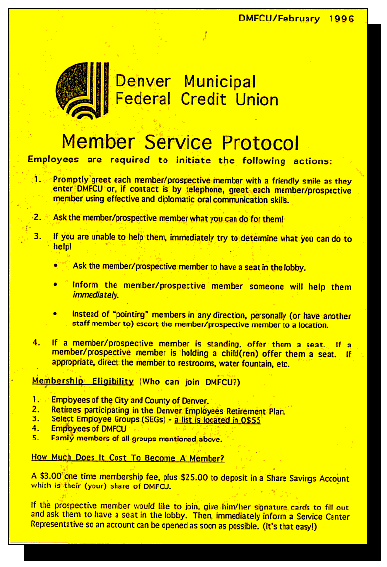
At DMFCU I proposed, designed and distributed a
training tool to communicate customer/member
service protocols. Laminated copies of the
following document were placed on the desks of
ALL employees. |
|
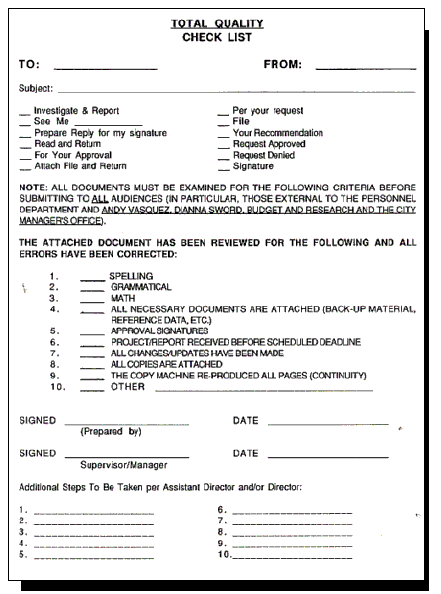
At the City
of Dallas, to train, monitor and evaluate staff
performance, I created and required my staff to
complete a Quality Control Checklist before sending
or distributing any correspondence from my
division. |
|
|
|
|
|
|