| PROJECT MANAGEMENT, ORGANIZATIONAL AND BUSINESS DEVELOPMENT |
| It's because I possess this . . . |
 |
Easily validated because I've done this . . . |
|
That's why I excel at doing this: |
SUBJECT MATTER
EXPERTISE |
|
DELIVERABLES |
|
PROJECT
MANAGEMENT & OD |
(SME) - Compensation / Position & Change Management / Job Design & Job Evaluation / Recruitment & Selection (local, regional, national & international) / Training / Organizational Development / Performance Management (design, orchestration, assessment, validation) / Employee & Labor Relations / Health Benefits Managed Care, Wellness & Cost Containment / HRIS / Employee Assistance Programs / Deferred Compensation / TQM (with Zero Base Budgeting, ISO, RUP, Six Sigma, Lean, etc.) / HRIS / Employee Communications (print, broadcast, intranet/internet) / Ethics / AA/EEO/ADA/DEI
Environments - Private & public sector / Profit & Non-profit / Union & Non-union / Multi-site, Multi-state & International / Average employee population serviced is 9,611 and has ranged from < 100 to > 60,000; plus a broadcast audience of 490,000+
Industries - Broadcasting / Aerospace / Public Education (K-12 and collegiate) / Finance / Healthcare (acute, long-term care, medical research) / Fundraising / Gaming / Manufacturing / Municipal Government / IT / Retail / Property & Casualty Insurance / Human Resource Consulting / Media Relations
"Confidence to achieve OD objectives comes from strategic plans anchored to
pre-determined, proven outcomes! It's not guesswork. There's no gray!"
Trip Reynolds
|
| 1. Diverse HR management experience in public/private sector, profit/non-profit, union/non-union, multi-site/multi-state, and international environments. |
| 2. Diverse HR management experience in aerospace, public education, financial services, health care, gaming, IT, retail, manufacturing, municipal government, property/casualty insurance, broadcasting, and HR Consulting. |
| 3. Created/recruited over 50,000 jobs. |
| 4. Diverse HR management experience designing entire departments from scratch, including all related project management, position hierarchy, job design, job standards, compensation, recruitment and staffing, and creation and alignment of strategic business unit objectives in compliance with company objectives and employment law.
|
| 5. Conducted performance management (reviewed and approved) 443,810 employee performance evaluations!
|
| 6. Directed health benefits; lead and validated 68% drop in health claims by wellness program members vs. a 79% increase in health claims by non-members. |
| 7. Produced, filmed, edited, and broadcast 35,760+ hours of community-based content; increased development revenue by 225%
in less than 7 months! |
| 8. Diverse subject matter expertise successfully conducting fund raising campaigns. |
| 9. Diverse subject matter expertise in employee/labor relations. |
| 10. Diverse subject matter expertise in training and development, and proprietary seminars. |
| 11. Won 100% of self-represented unemployment claims. |
| 12. Managed comp programs from $1 million to $507 million! |
| 13. SME in proprietary HRIS/ERP installation, maintenance, and data analytics, including RFPs. |
| 14. SME in all HR communications, including newsletters, intranet/HTML, and audio/video.
|
| 15. Evaluated over 7,000 jobs. |
| 16. Wrote over 7,200 job descriptions. |
| 17. Wrote over 3,000 policies; wrote dozens of employee handbooks.
|
| 18. Conducted over 3,500 job audits. |
| 19. Created over 2,500 salary schedules. |
| 20. Never used any sick days. |
| 21. Never filed any health claims. |
|
The ultimate purpose of organizational and business development, and its achievement through project management, is to move from one paradigm - typically perceived as inefficient or dysfunctional - to a paradigm that provides for the strategic achievement of better performance outcomes.
I’ve designed thousands of corporate-wide departmental reorganizations, from top to bottom, involving all FLSA exempt and non-exempt positions, including all aspects of performance management. I know exactly how to get you there through:
 Strategic PM Team Leadership Strategic PM Team Leadership
PM Policy and Planning
HRIS/ERP/Data management, analytics, and IT integration
Alignment of technology to achieve strategic scope of business unit outcomes.
Job design, job evaluation and position hierarchy with specific and validated performance and compensation outcomes.
Design of infrastructure, operational systems, and materials management with specific and validated performance outcomes.
Achievement of AA/EEO/ADA/DEI objectives compliance with employment law
Communications: Internal audiences; external audiences; public speaking; seminars; training and development; graphics, print, broadcast, HTML, and media/public relations
|
To download OD profile, click here. To download related Total Rewards profile, click here.
Note: When
provided with an interview, I will freely discuss the
strategy/philosophy associated with the following
exhibits.
|
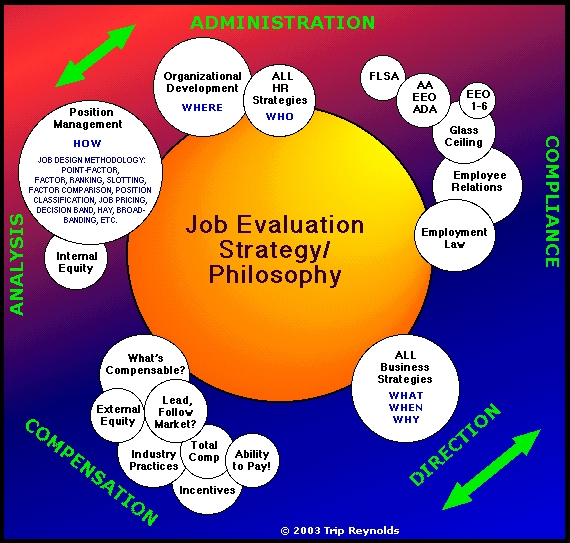
POSITION MANAGEMENT
Job Evaluation, and Organizational Development are concurrent events for effective human resource management.
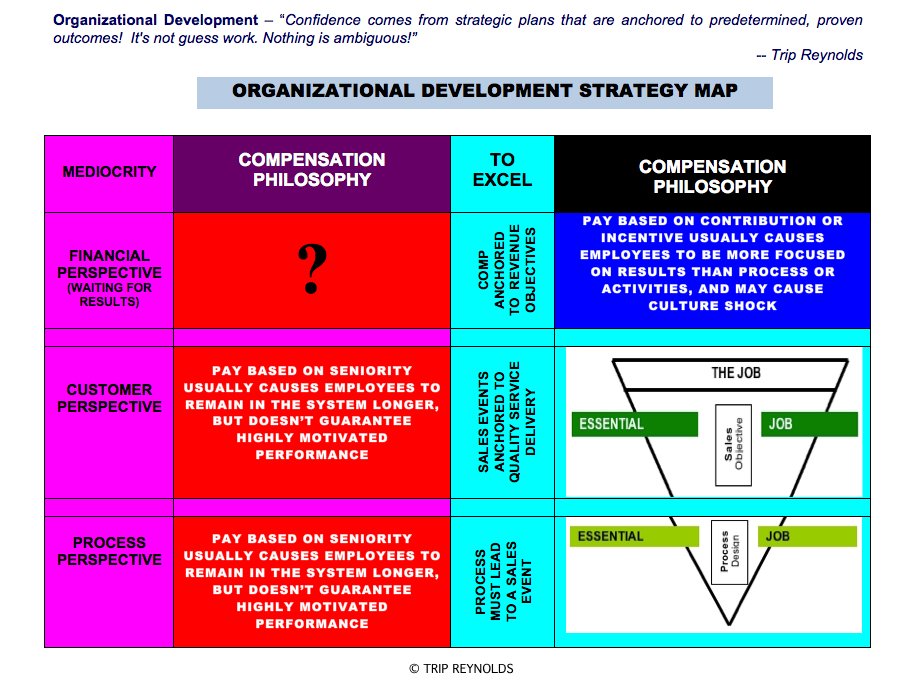
"Confidence to achieve organizational development objectives comes from strategic plans that are anchored to predetermined, proven outcomes! It's not guess work. There's no gray!" Trip Reynolds
|
|
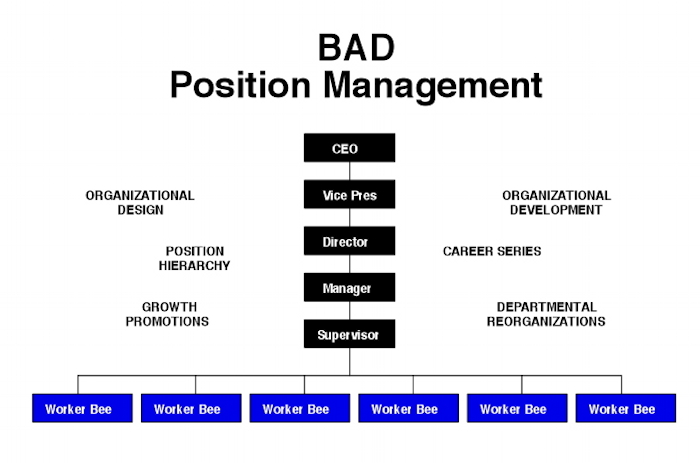
BAD POSITION MANAGEMENT
"Top heavy" (1-on-1) reporting relationships do not achieve efficiencies in productivity, but
only inflated salaries for management and with absolutely no corresponding return-on-investment in human capital (worker bees) immediately responsible for producing the work.
|
|
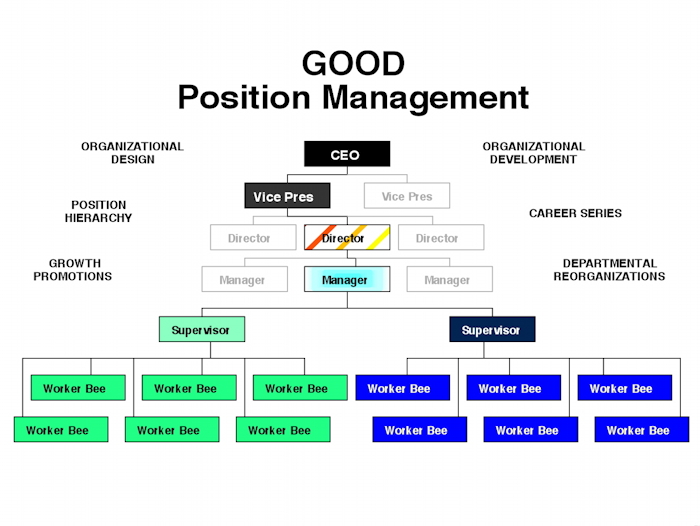
GOOD POSITION MANAGEMENT
Reporting relationships achieve efficiencies in productivity, and without inflated salaries for non-performing tiers of 1-on-1 management hierarchy. |
ORGANIZATIONAL DEVELOPMENT (TEAM BUILDING)
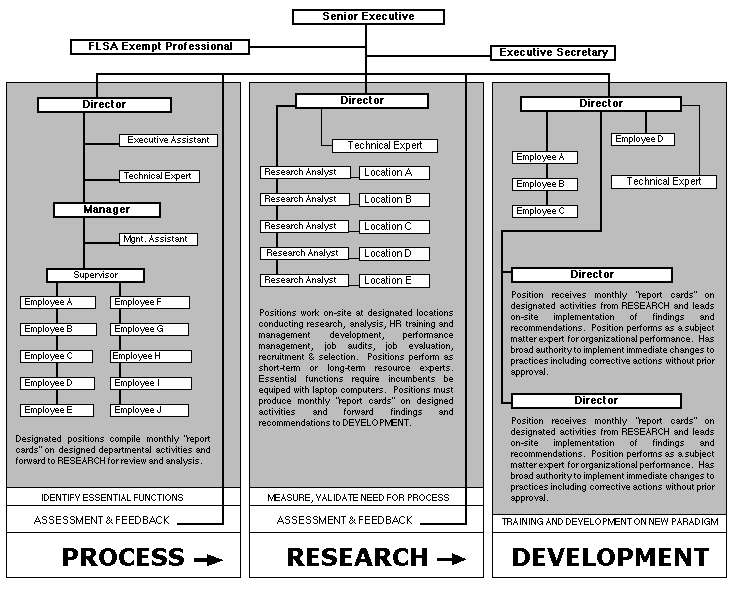
Without regard to existing position hierarchy, the ultimate purpose of organizational development is to move from one paradigm - typically perceived as inefficient or dysfunctional - to a paradigm that provides for the achievement of better performance outcomes. Having literally designed thousands of departmental and corporate-wide reorganizations, I know exactly how to get you there. Consider the following:
1. Anchor the essential functions performed by all staff to standards established to support internal and external clients in their achievement of strategic business unit objectives. Is the right work being performed by the right position(s) and is it being performed correctly? Can you validate the reallocation of materials, supplies, equipment and staff in the absence of proven performance outcomes?
2. Challenge existing staff or teams of employees who, in the absence of clearly defined strategic business unit objectives, establish short-term or long-term RESEARCH units to conduct OD.
3. Discontinue all legacy practices of using non-subject matter experts to manage employer/corporate functions in which they have no or little expertise actually designing "jobs" and "job standards." Think about it: Are you giving way too much value to "internal "politics" that consistently represent failure, negligence and incompetence?
4. Don't reorganize, don't spend any money, don't reallocate resources unless performance outcomes (i.e., ROI = return on investment) validate the time and expense required. Remember, it's not guess work.
|
|
HR versus OD?
Effective "Human Resources" supersedes every aspect of TQM, ISO, Lean, and Six Sigma, because these consultant-driven workforce stratagems are “esoteric” concepts that typically exist as:
(a) offshoots of pre-existing HR disciplines (job evaluation, job design, position classification, performance management, etc.);
(b) only installed at medium-to-large employers with a revenue base to support their existence separate from or as a part of HR; or
(c) only installed where HR has failed to effectively design and manage positions (human capital performance) to achieve strategic business unit objectives. |
THE VALUE OF JOB AUDITS - I wasn’t a member of the IT Department at Boeing/Jeppesen, so I’m not “supposed” to know how to write code, but I’ve conducted hundreds of job audits of IT positions to acquire the knowledge to write code; so, I designed and installed an intranet web site for subsidiary compensation services (Jeppesen) that was 8 times faster/more efficient than a similar site managed by the parent corporation (Boeing). This is what I do! I identify inefficiencies in job design, I identify inefficiencies in process and production, and I identify inefficiencies in service delivery to achieve strategic business unit objectives – and I’m consistently successful in doing this.
|
I’ve conducted over 3,500 job audits in extremely diverse work environments, which actually involves meeting with employees, studying exactly how they perform their essential job functions, and then directing the employee to step aside as they monitor me performing their work. Again, I’ve done this well over 3,500 times. I use the “hands-on” knowledge I’ve acquired to evaluate the job: (1) determine if any of the essential job functions should be added, deleted, or revised and how; (2) determine departmental and company-wide position hierarchy and reporting relationships; and (3) to price the value of the job in the marketplace. I do not have “tunnel vision” which is blatantly common with TQM professionals, because my scope of knowledge is extremely robust (acquired from hundreds of employers in diverse industries) and first-hand from actually doing the work of employees: from performing soil compaction tests to designing web sites; from changing ballasts 80 feet above a concrete floor at a waste water treatment facility to operating a drill press to make signs for an interstate highway.
|
• Managed the
classification and evaluation of thousands of positions
to establish and maintain internal equity and external
competitiveness. Facilitated change management for nearly
1,000 departmental reorganizations, in private and public
sector, profit and non-profit, union and non-union
environments.
• Managed position
classifications used to categorize over 48,000 employees
in diverse public and private sector industries. Job
evaluation and position categorization methods used
includes point-factor, factor, Hay, FES, ranking,
slotting, forced distribution, decision band,
broad-banding, cluster, and job pricing.
Upon request, with
work product beginning as early as 1977, copies of
benchmark generic and proprietary work product
involving job evaluations and position management can
be provided.
• Conceived,
designed and implemented four original point-factor job
evaluation plans. Copies of these documents are available
upon request.
Specific example 1 (2019): Crete Public Schools and the bargaining unit for teachers, Crete Education Association, were unaware of the inequitable design of its teacher salary schedule.
What did I deliver: Conducted original research that validated inequitable compensation practices (Excel, or PDF), and informed CEA and CPS that without regard to the number of years worked or the amount of education acquired, CPS provides a flat increase of $1,609.95 to all teachers. At CPS, the percent of increase paid to teachers is progressively less as they acquire more education, and likewise, the percent of increase is progressively less as teachers work additional years (step increase). Or, said differently, CPS wants teachers to constantly improve their skill sets, to improve the educational performance of students, but pay teachers progressively less. This negative interpretation of compensation practices is not in the best interest of Crete Public Schools.
Specific example 2 (2017): Independent analysis of inequitable compensation at Sarpy County, NE (2017)
Salary schedule overview, click here.
Salary schedule analysis (Excel), click here.
Bargaining unit analysis, click here.
Specific example 3: At Denver Public Schools: Over the course of five
years, three attempts by the district (senior HR
management) and external HR consultants to negotiate a
new position classification system with the bargaining
group for clerical employees had all failed. Negotiations
were routinely deadlocked on this issue.
What did I
deliver: I conceived and designed an original
point-factor job evaluation systems for the specific
evaluation of office/clerical positions, and presented
the system to both senior HR management and to the
leadership of the bargaining group for clerical
employees. Both parties accepted the plan. Then, as a
"team building" effort, and to validate (for the
bargaining group) the objectivity of the system, I
trained the bargaining group leadership on the actual
administration of the plan. For the first time, the
bargaining group held primary responsibility for
defining position relationships and compensatory
values for all office/clerical positions.
Specific example
4: At the City of Dallas: Senior management outside
the HR department expressed concerns about perceived
inequities in the evaluation of mid-level management and
supervisory positions.
What did I
deliver: I researched, designed and managed two
original point-factor job evaluation systems - one was
PC based, and the other a traditional manually
factored matrix. In compliance with budget
considerations, this project took approximately 1.5 to
2 years to implement. Plus, I directly managed staff
in converting existing mid-level management jobs into
the new paradigm. Additionally, I coordinated the
efforts of staff and outside HR consultants in the
complete overhaul of a new job evaluation system
anchored to market pricing. Notably, in the wake of
the consultants, I was the "key" player to both
identify and correct critical errors made by the
consultants. Given the typically transient nature of
municipal government, I performed as the "key" person
responsible for the numerous "top to bottom" changes
in departmental operations, which were often vague, as
established by newly elected officials or newly
appointed senior administrators. Fast-paced or
constantly changing environments require due diligence
to avoid creating new or exasperating existing
inequities, and I successfully lead management in this
regard.
Specific example
5: At the City of Dallas: the Chief of Police complained the essential job functions performed by Police Dispatch were as complex as Fire Dispatch, but Police Dispatch was not compensated as highly as Fire Dispatch.
What did I
deliver: I researched, conducted on-site job audits of both police dispatch operations and fire dispatch operations, and determined the complexity and character and scope of work performed by Fire Dispatch was superior to the Police Dispatch. To read the analysis, click here.
|
|