To download Total Rewards profile, click here.
To download Compensation and Benefits profile, click here.
To download Compensation profile, click here.
(Download) How to Determine Salary Placement
(Download) How to Write Job Standards
DPS-HR.com, an intranet inventory of all company jobs descriptions,
salary schedules and related data.
JeppJobs.com,
an intranet inventory of all company jobs descriptions,
salary schedules and related data.
FAMC-HR.com,
an intranet inventory of all company jobs descriptions,
salary schedules and related data.
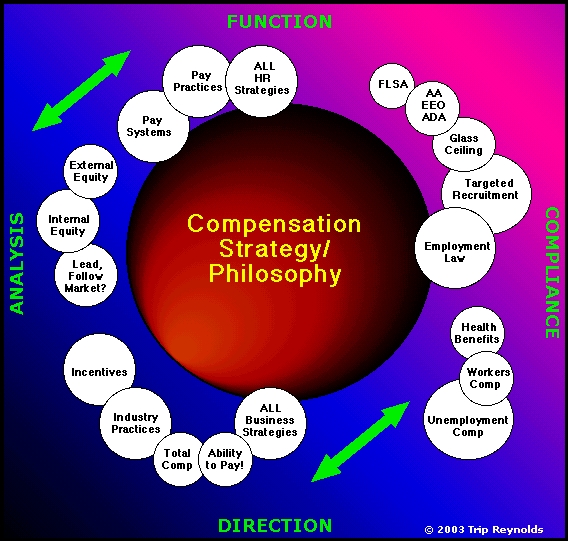
Note: When provided
with an interview, I will freely discuss the
strategy/philosophy associated with the
exhibit at right.
• Directed and managed major compensation programs,
including organizational development/change management,
job evaluation (Hay, FES, ranking, slotting, forced
distribution, cluster, job pricing, etc.), salary surveys
(local, regional, national, international), equity
analysis, executive compensation, variable sales incentive plan design, legal compliance (FLSA, etc.),
and pay for performance systems.
|
|
• Guided executive management on organizational development and how to achieve
strategic business outcomes through the integration of
compensation philosophy, position management and job
design.
• Managed employee compensation programs ranging
from less than $1 million to $507 million in salary
expenditures. Directly managed merit reviews and
subsequent salary approvals for over 20,000
employees.
• Identified and corrected thousands of salary inequities, such as: City of Dallas; Denver Public Schools; Boeing/Jeppesen; Greater Omaha Chamber
•
Designed/developed/administered a wide variety of performance based merit
systems in both public and private sector environments,
profit and non-profit, union and non-union. For example:
• Developed total
compensation programs and, when appropriate, worked
constructively with brokers and actuaries.
• Managed HR information systems, including desktop PC data
base systems; wrote RFPs and evaluated HRIS vendors; lead
the research, coordination, implementation and
conversions from internally designed (IBM mainframe) HRIS
to proprietary HRIS (JDEdwards, Lawson) running on an
AS/400; self-acquired knowledge of PeopleSoft, ADP and
other HRIS.
• Performed
payroll administration through J.D.Edwards (HR Certification),
Lawson (HR Certification), Great Plains, ADP, and other proprietary HRIS.
• Wrote four
salary administration manuals, for four different
employers. All manuals are available for review upon
request.
•
Consistently directed and managed staff,
and counseled and trained management to think
"outside of the box" in the delivery of compensation and
reward systems. |
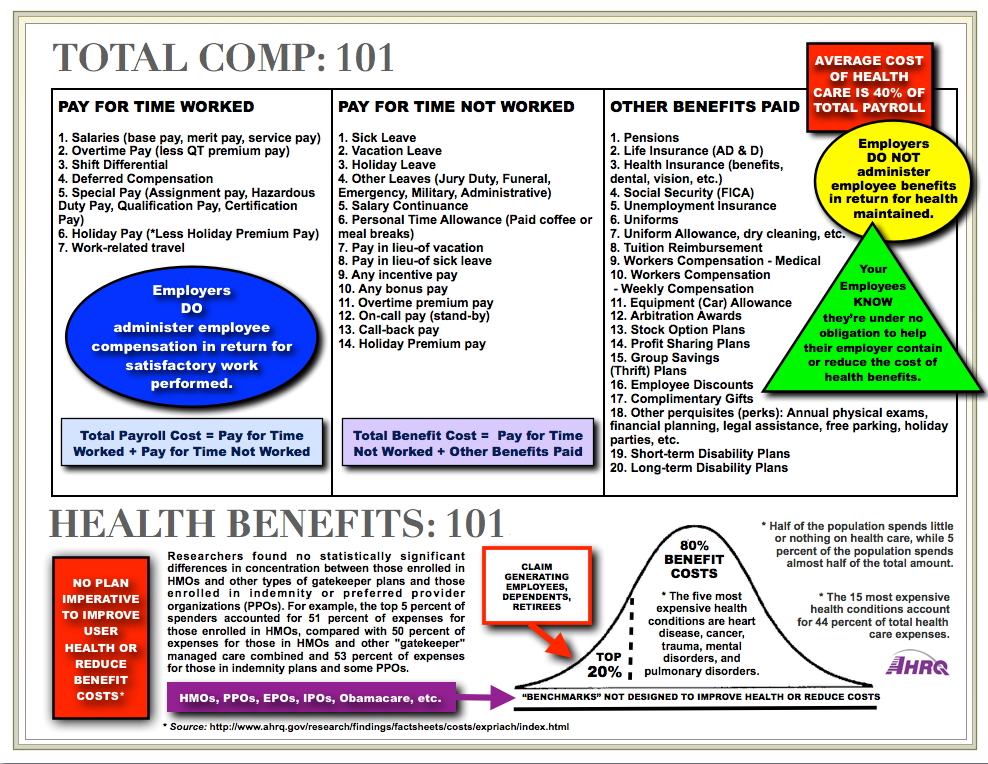
WHAT IS THE "BIG PICTURE" OF "TOTAL COMP" ? |
|
| |
CHARACTER AND SCOPE OF REYNOLDS' WORK WHEN "TOTAL COMP" INCLUDES HEALTH BENEFITS |
MY ROLE
|
EMPLOYER
|
MY RESPONSIBILITY ANNUAL COMP
|
MY RESPONSIBILITY
ANNUAL BENEFITS
|
HR
Management Consultant
|
Reynos –
Omaha, NE – Sole Proprietor / Private Sector
|
Clients: $482,835 to $5.5 million
|
Total payments: $175,330 to $7,778,327
|
Manager
of Human Resources
|
Fremont
Area Medical Center – Fremont, NE – 900 Employees / Public
Sector
|
Total payments: $27
million
|
Total
payments: $6,141,757 [Actual total medical $5,267,238.94]
|
Program Manager/Compensation
|
Jeppesen/Boeing –
Englewood, CO - 2,000 Employees / Private Sector
|
Total payments: $80,000,000
|
Total payments: N/A. Proprietary Boeing Corporation.
|
Program Director/Compensation
|
Denver
Public Schools – Denver, CO - 17, 600 Employees / Public
Sector
|
Total payments: $425,000,000
|
Total payments (approx):
$46,441,297
|
Vice President of Human Resources
|
Denver
Municipal Federal Credit Union – Denver, CO - 55
Employees
|
Total
payments: $1,500,000
|
Total
payments (approx): $165,000
|
Manager of Employment,
Compensation, and Employee Relations
|
National
Jewish Medical Center – Denver, CO - 1,500 Employees / Non-Profit
|
Total payments: $60,000,000
|
Total payments (approx):
$6,600,350
|
Manager, Personal Programs
|
City of
Dallas – Dallas, TX - 17,100 Employees / Public Sector
|
Total payments: $507,000,000
|
Total
payments (approx): $49,533,297
|
|
|
Throughout my entire HR career, I've
designed thousands of salary schedules with every
imaginable twist in anticipation of or in response to a
constantly changing compensatory environment. Directly
responsible for the design (including desktop publishing)
and communication of all compensation related information
via memorandum, manuals, brochures, administrative
directives, Internet (including HTML design), and both
formal and informal presentations before staff, senior
management and executive boards.
Reynos Consulting:
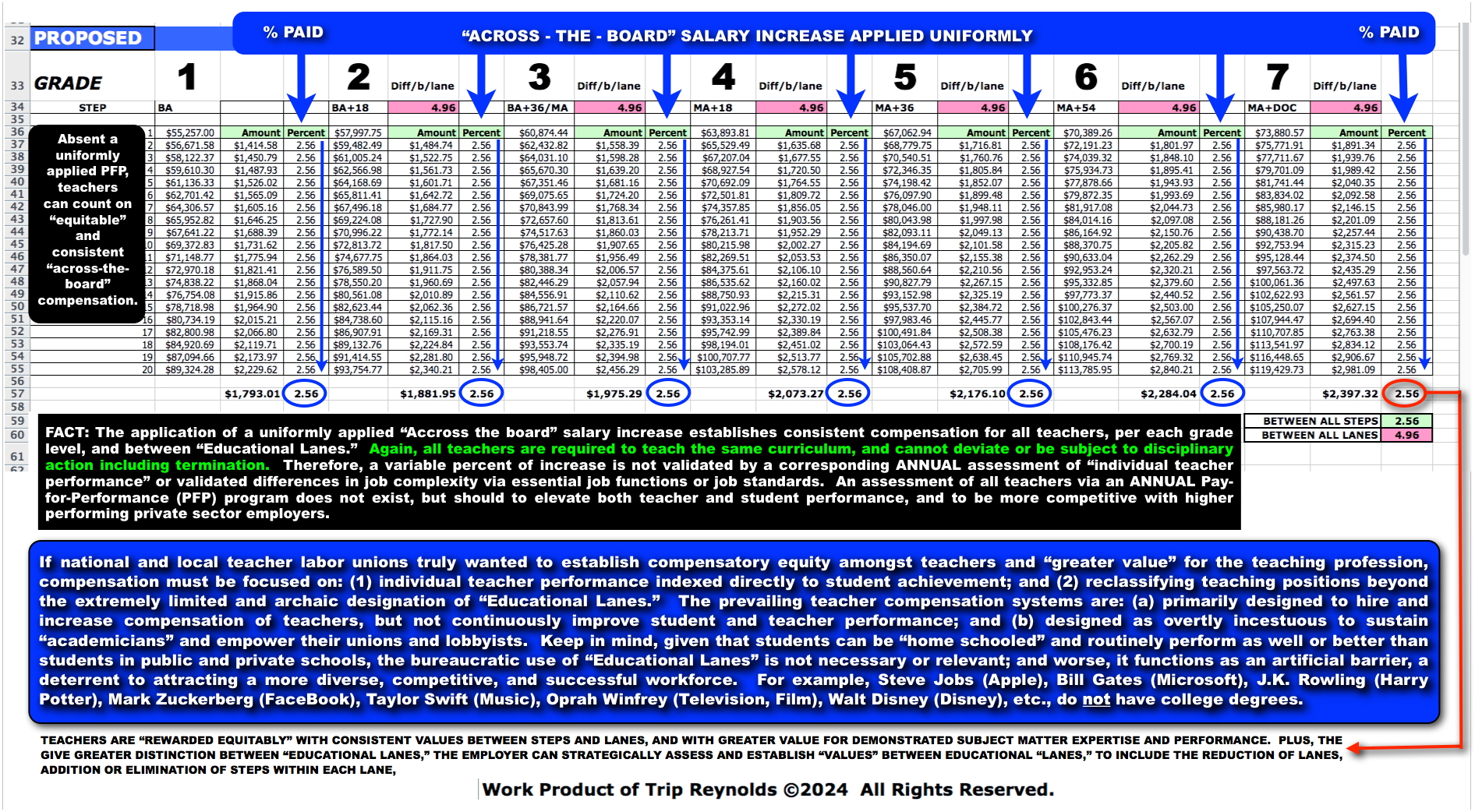
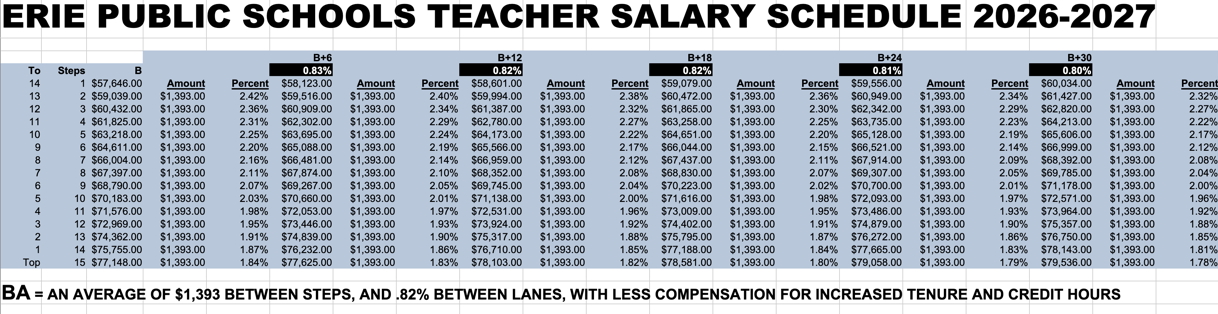
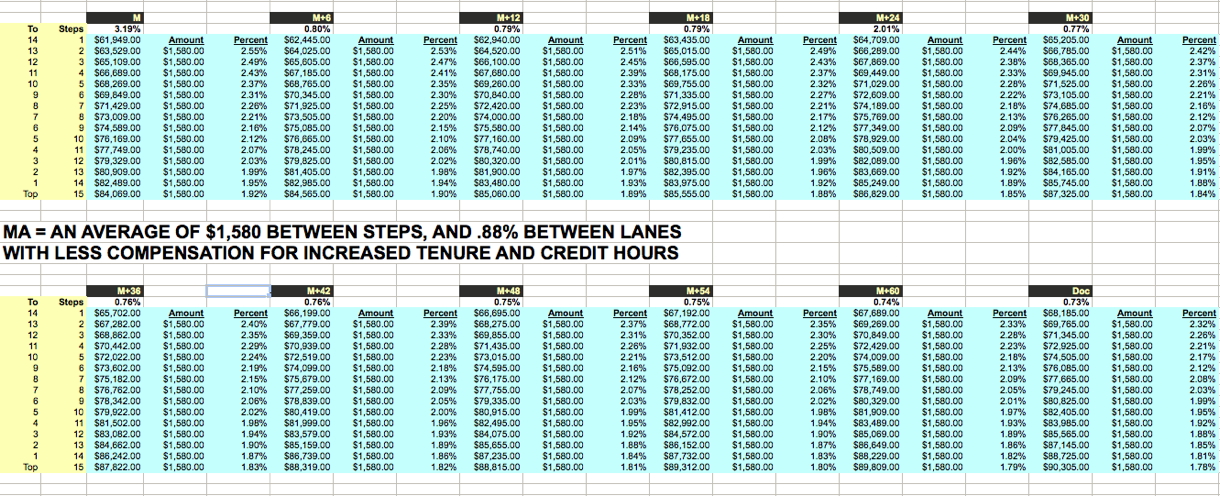
2026 - Teacher compensation at Erie Public Schools: Teachers have "less value" the longer they work and as they acquire more educational hours and degrees. Performance is NOT relevant to compensation. Click image below to enlarge; to review data, click here.
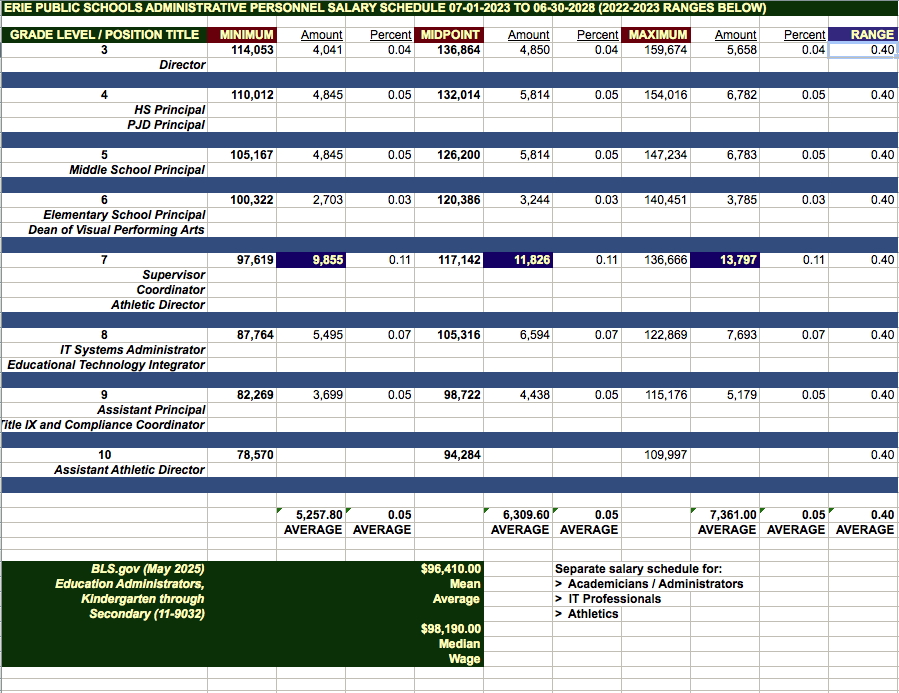
Administrator compensation at Erie Public Schools:
(1) Salary range spread is only 40%, much less than the well-established, more market competitive and "usual and customary" market standard of 60% to 65%;
(2) In the wake of the early 1980s Wage and Price Control Guideline, EPS failed to create a separate schedules for IT staff, which directly limited recruitment and selection of qualified IT staff; plus, most importantly, by definition and function, IT staff are NOT academicians, and should not be compensated via the Administrator Salary Schedule;
(3) By definition and function, an athletics director is not an academician (immediately responsible for implementing and teaching curriculum), but primarily: (a) directs an athletic department, including budgeting, fundraising, personnel management; (b) ensuring compliance with high school league rules and regulations; (c) hiring and supervision of coaches and other athletic staff; (d) ensuring that all team members adhere to appropriate ethical and safety standards; (e) development and implementation of training and conditioning programs for student-athletes; (f) scheduling of games and competitions; (g) building relationships with alumni, boosters, and other key stakeholders; (h) securing funding for the program through donations and other means. View data below, or to review data, click here.
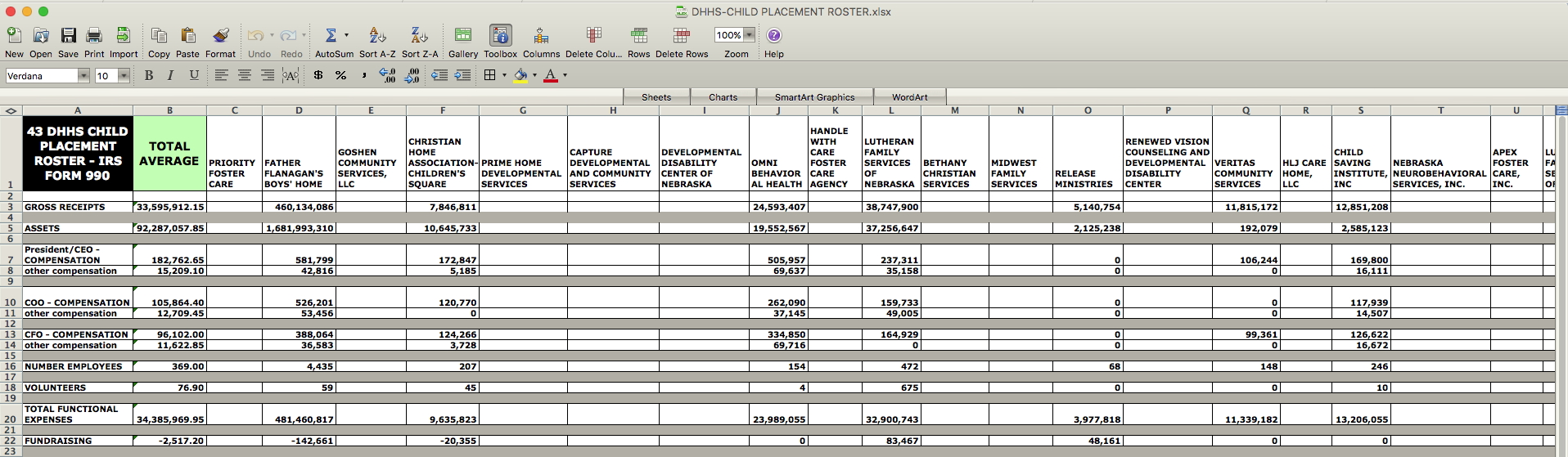
2025 - Pay comparisons in executive compensation at "Child Placement Providers" authorized by Nebraska's Department of Health and Human Services. Click image below to enlarge; to review data, click here.
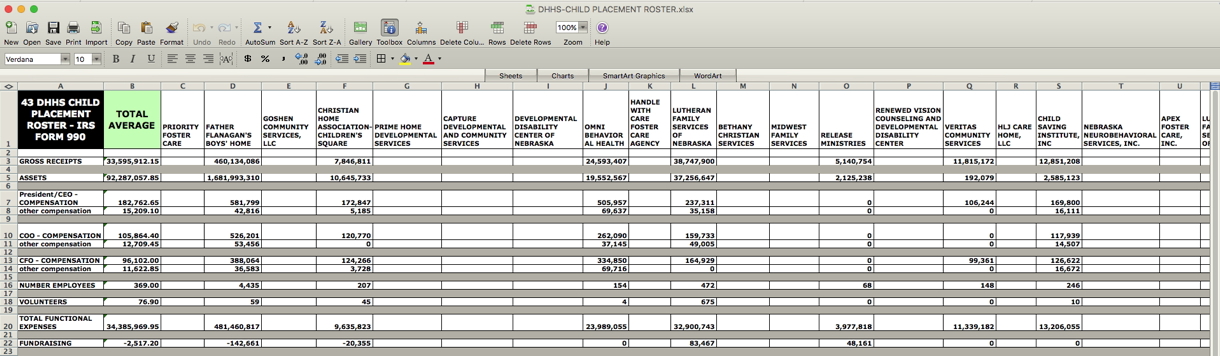 Source: IRS Form 990 for designted non-profits Source: IRS Form 990 for designted non-profits
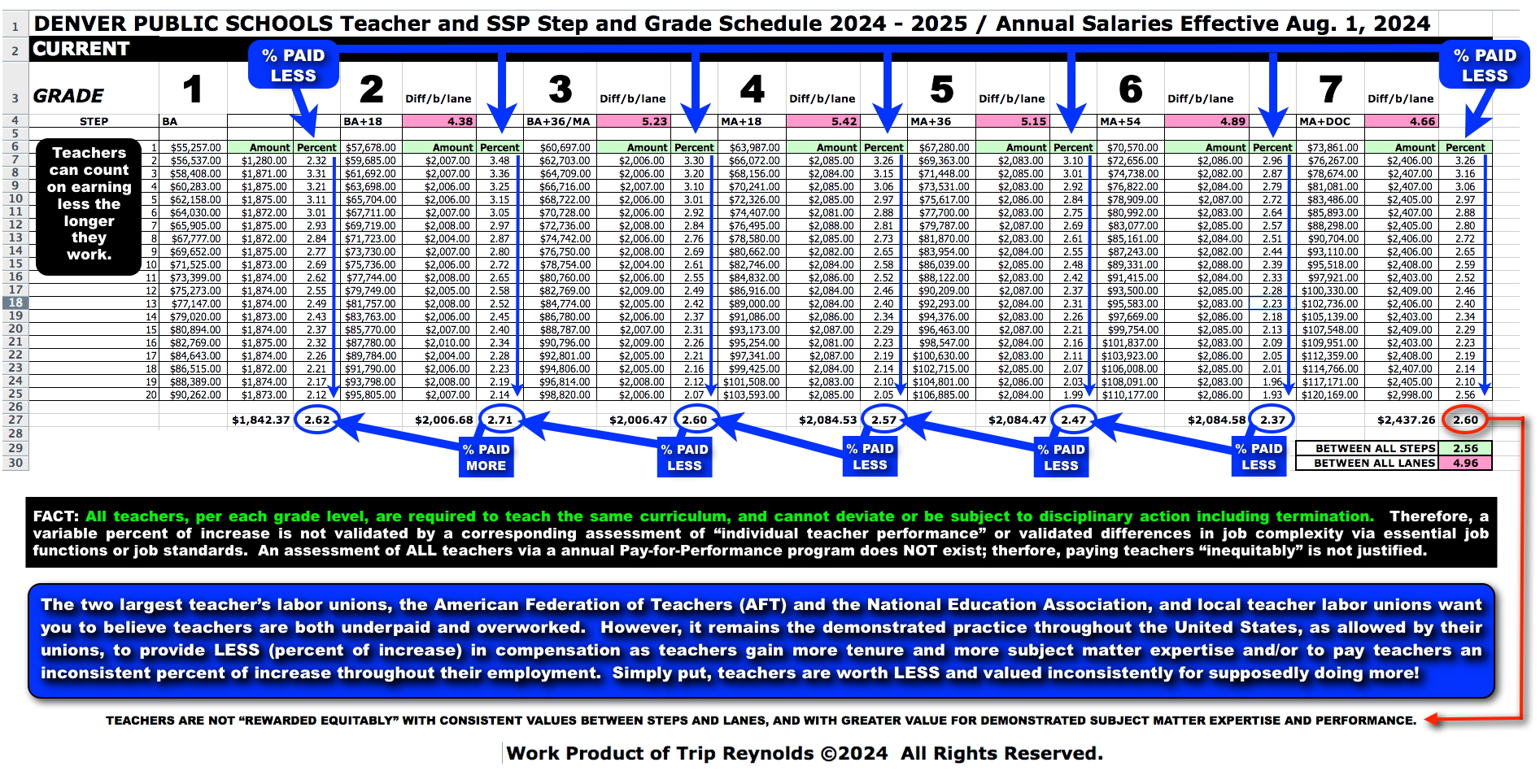
2024 - Teacher compensation at Denver Public Schools. Teachers have "less value" the longer they work and as they acquire more educational hours and degrees.
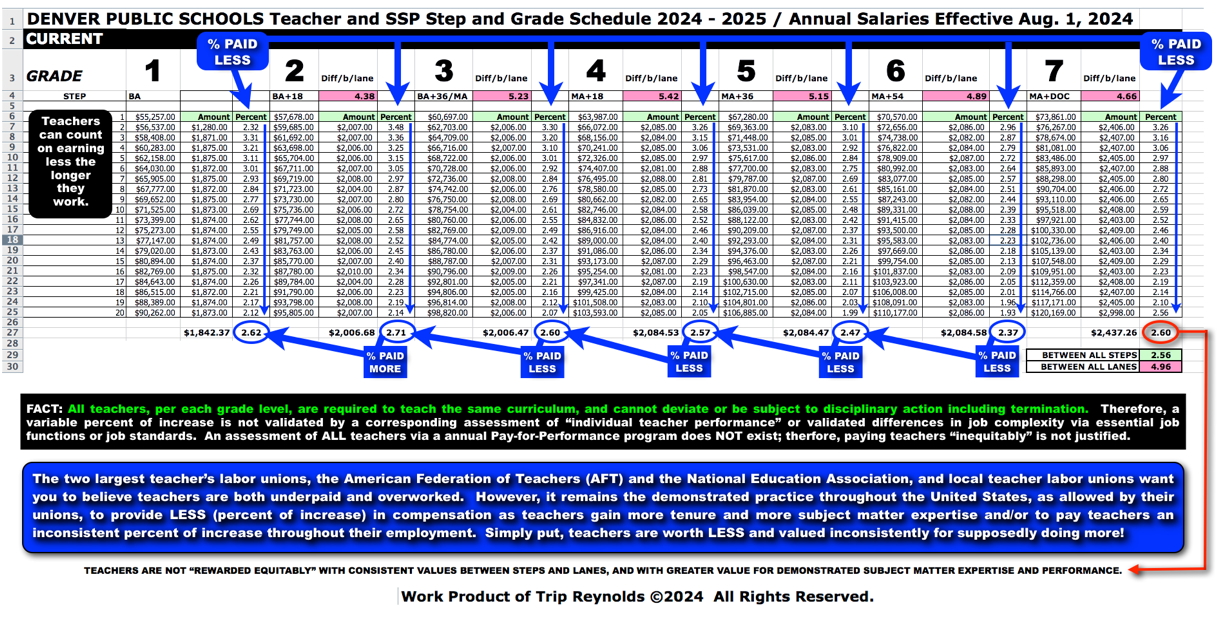
CLICK ABOVE IMAGE TO ENLARGE
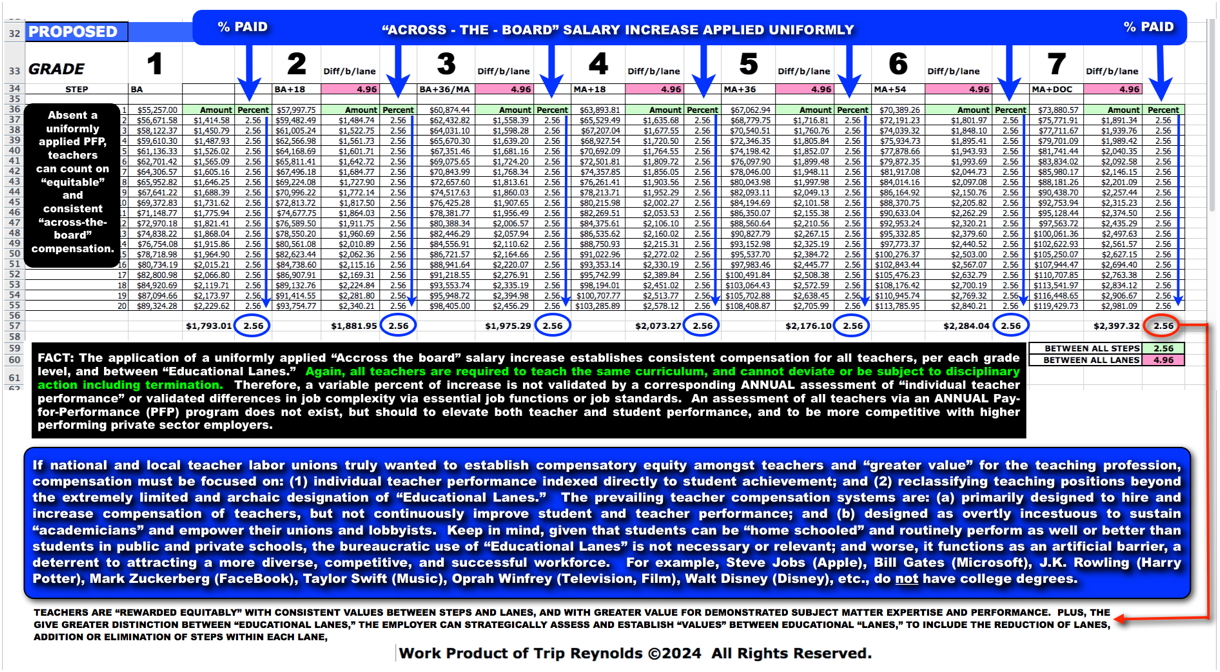
CLICK ABOVE IMAGE TO ENLARGE
2023 - Greater Omaha Chamber of Commerce
Between 1978 and 2019 CEO compensation has grown 940% while typical worker compensation has risen by only 12% during this same time, which is often perceived as obscene by many members of the "rank and file." In January 2023 a local multimedia client engaged me to review highly paid executive compensation particular to non-profits in metro Omaha. As validated by research from the Bureau of Labor Statistics (below), the average compensation for Chief Executive Officers in Omaha-Council Bluffs is $239,610. Therefore, one might "assume" compensation paid to the CEO of the Greater Omaha Chamber of Commerce is comparable, right?
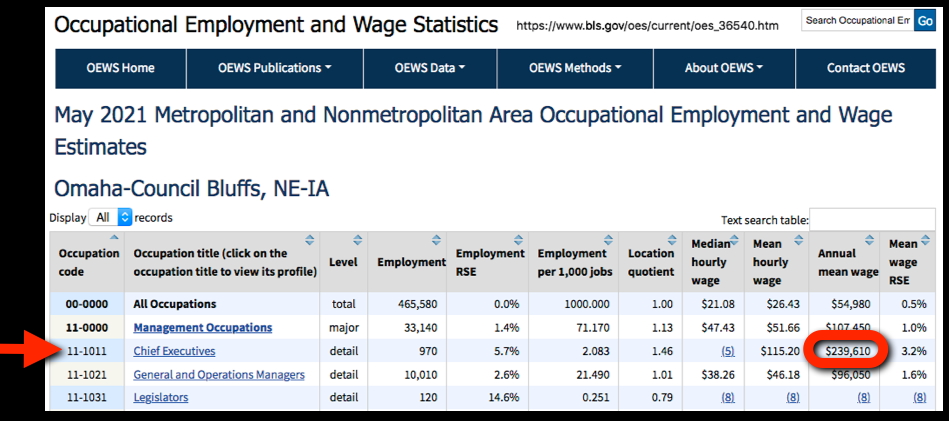
As validated by the Greater Omaha Chamber's IRS Form 990 (below), in 2019, compensation paid to the Chambers' Chief Executive Officer, David Brown, was 239% greater than the average annual compensation paid to CEOs in 2021 for metro Omaha-Council Bluffs? That's right, $812,171 versus $239,610. Is membership in the Greater Omaha Chamber truly a valid "benefit," providing return on the investment (ROI) for its members, or is the Chamber's CEO the biggest beneficiary?
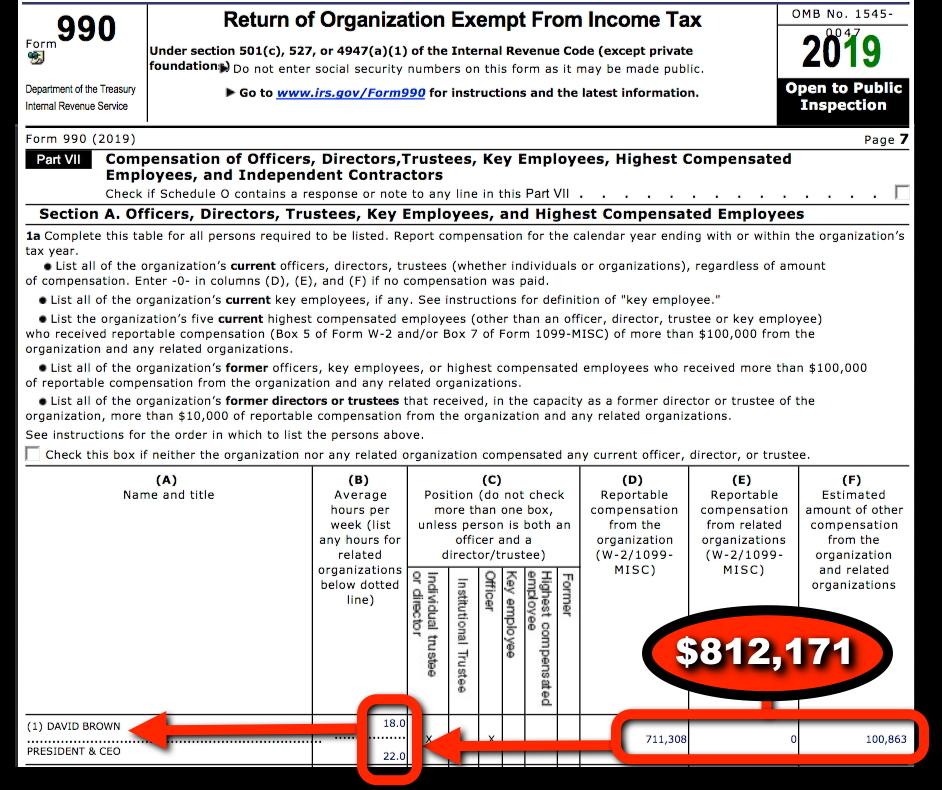
Given that many CEOs who are members of the Greater Omaha Chamber hold positions with considerably more employees, greater complexity of workforce dynamics (technology, healthcare, agriculture, manufacturing, etc.), greater span of control (public/private sector, profit/non-profit, union/non-union, multi-site/multi-state, and international environments), greater risk from potential work related hazards, greater diversity of work conditions, etc., why does the Chamber compensate its CEO 239% greater than the average annual compensation paid to CEOs in 2021 for metro Omaha-Council Bluffs? Consider the following snapshot:
Company |
CEO |
W2 |
Other Comp |
Total |
# Employees |
Source |
Year |
| Greater Omaha Chamber |
David Brown |
$711,308 |
100,863 |
$812,171 |
46 |
IRS Form 990 |
2019 |
|
| Nebraska Humane Society |
Nancy Hintz |
192,255 |
0 |
192,255 |
240 |
IRS Form 990 |
2019 |
|
| Nebraska Medicine |
James Linder |
1,423,430 |
29,084 |
1,452,514 |
8,000 |
IRS Form 990 |
2020 |
|
| Nebraska Methodist College |
Jeffrey Francis |
547,699 |
120,992 |
668,691 |
397 |
IRS Form 990 |
2019 |
The above exhibit has absolutely nothing to do with playing the "race card," because, clearly, the "Business Card" is being played with the above assessment. When talking about "business," for both for-profit and non-profit employers, how employers spend (invest) their money is measured as ROI, which ultimately is about performance. With regard to "performance," I've personally reviewed and/or approved 443,810 performance evaluations; I wield extremely robust subject matter expertise in this space (public/private sector, profit/non-profit, union/non-union, multi-site/multi-state, and international environments, which includes aerospace, public education, financial services, health care, gaming, IT, retail, manufacturing, municipal government, property/casualty insurance, broadcasting, and HR Consulting). Accordingly, my assessment of the Chamber's underperformance is consistent with my expertise evaluating the performance of employees, employers, and industries in my role directing all aspects of human capital management, including recruitment, compensation (including executive pay), organizational development, heatlh benefits, etc.
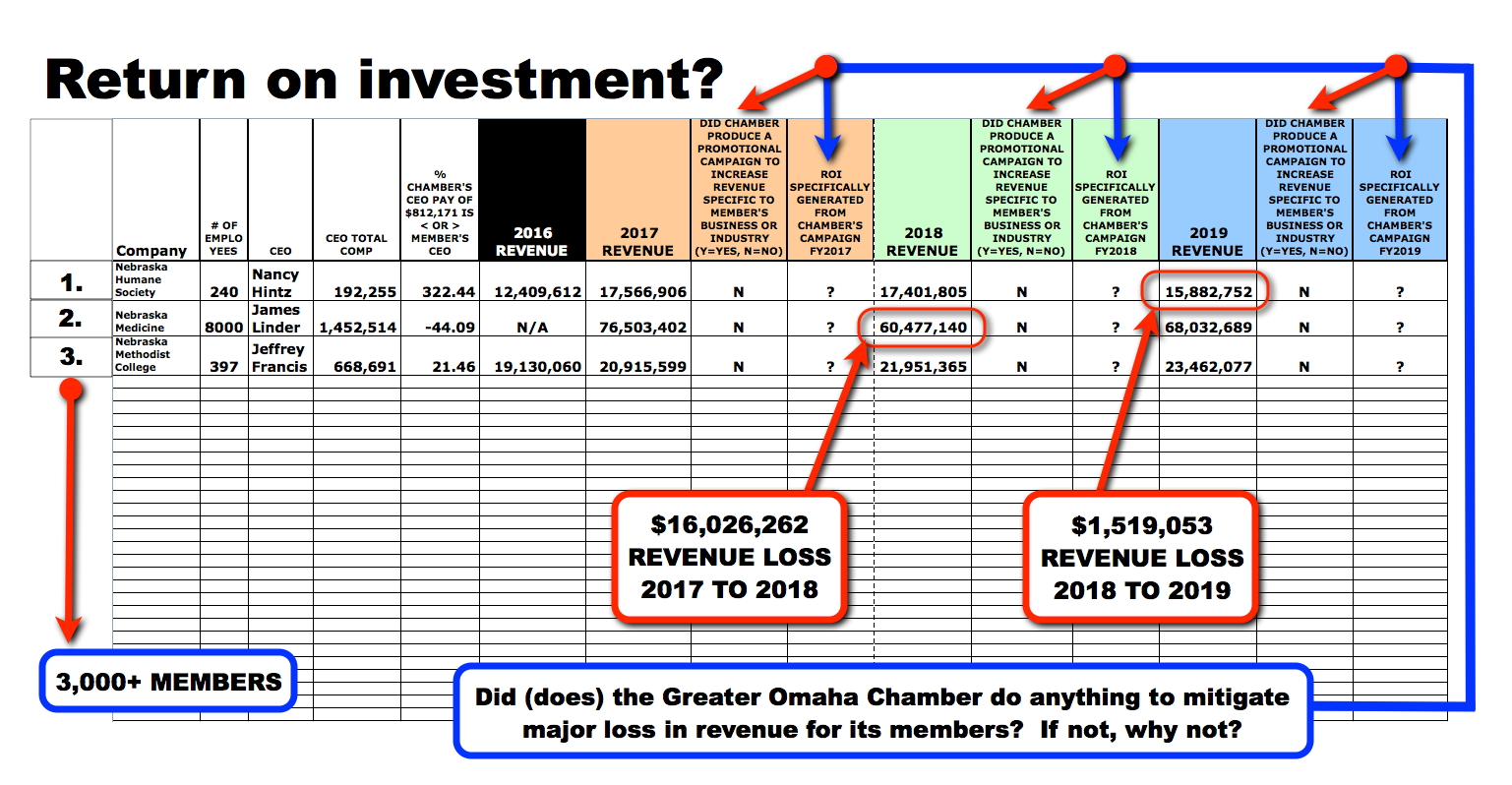
The Chamber's failure to provide a measurable ROI to its members should not be confined to the Chamber's staff, but include its Executive Committee, because they allow the underperformance. Frankly, no business should consider joining the Chamber or renew its membership unless the Chamber provides actual evidence membership will provide a measurable and immediate ROI. Note the following exhibit:
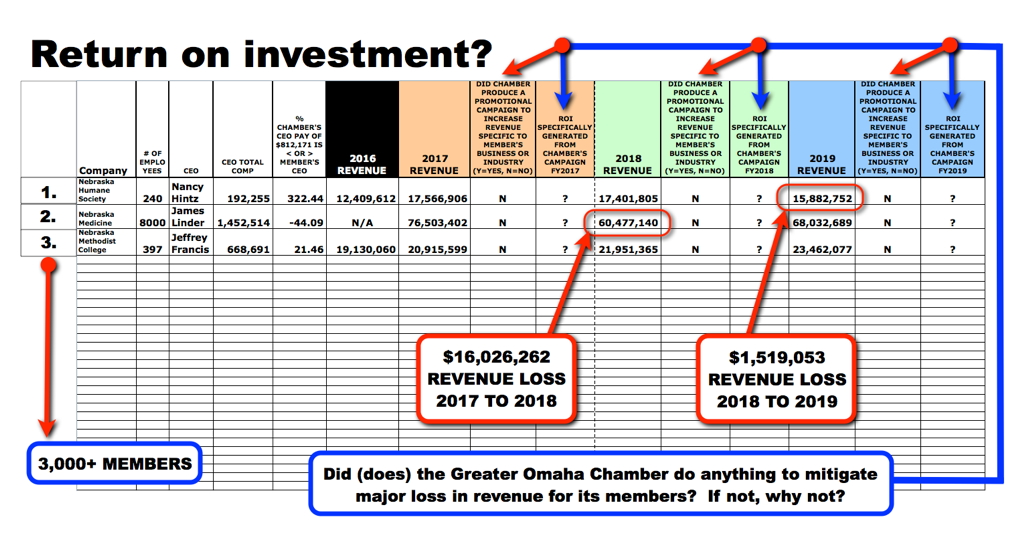
In summary, the "mission" of the Greater Omaha Chamber is to increase business "commerce," employment and investment. Equally important, if the Chamber is going to achieve its "mission," shouldn't it be aware of the financial health of its members?
At Jeppesen / Boeing:
PROBLEM: No delivery system for the communication and
distribution of compensation information.
What did I deliver: Designed and installed JeppJobs.com, an intranet for subsidiary compensation services
(Jeppesen) that's 8 times more efficient than a
similar site managed by the parent corporation
(Boeing); and conducted training seminars for staff and management on compensation.
PROBLEM: An inefficient sales and marketing function.
What did I deliver: Identified major deficiencies in corporate-wide sales, marketing, and product management strategies;
wrote a white-paper to prompt the evolution of product
management and sales practices, and the reengineering
of related compensation for product managers; wrote and implemented Sales
Incentive Plans for both U.S. domestic and
international sales staff; and created new career
series for product managers.
PROBLEM: An inequitably designed performance management
system.
What did I deliver: Identified major deficiencies in U.S. domestic performance management system - which
were not captured by Boeing Corporate - that
compressed the performance of minorities versus
providing corresponding increases in the performance
evaluations and compensation of non-minorities; and conducted training seminars on performance management:
•
91.22% of all "Moderately Effective" (below
standard) ratings were attached to Black and
Hispanic employees - although Black and
Hispanic employees constitute only 11.7% of
Jeppesen's U.S. based workforce.
•
60% of all "Moderately Effective" (below standard)
performance evaluations were attached to Black
employees - although Black employees constitute only
3.43% of Jeppesen's U.S. based
workforce.
PROBLEM: Recruitment Reps created internal salary inequities by establishing starting salaries for new hires significantly greater than the existing compensatory value of the work, including work performed by employees rated as excellent (4.0) or outstanding (5.0).
What did I deliver: Designed a "Job Offer Tool" that established specific guidelines for all new hires, promotions, etc., and trained management on its use. To review, please click here.
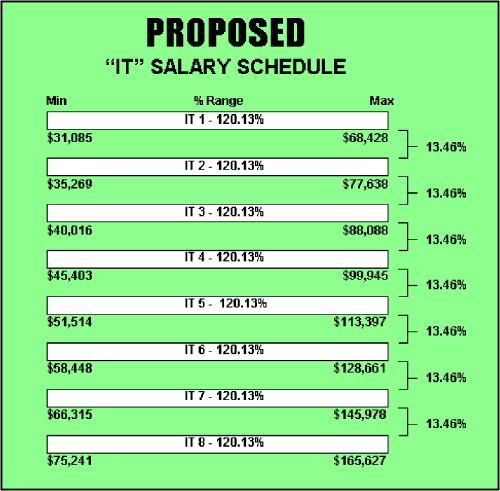
PROBLEM: An outdated IT salary schedule.
What did I deliver: Conducted a major
compensation analysis which included 200 job audits,
10 salary surveys; restructured the corporate IT
function, and established position equity. To download PowerPoint Presentation, please click here.
|
| |
|
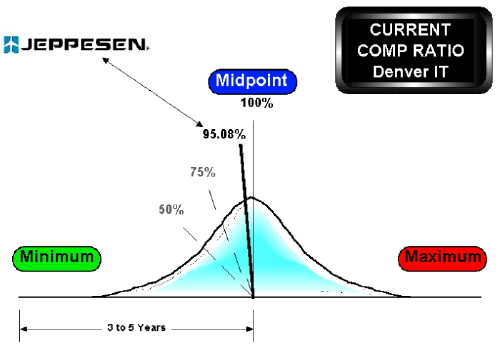
At left, an outdated, below market IT salary schedule.
To download PowerPoint Presentation, please click here.
|
What exactly are you paying for?
Click image below to review seminar brochure.
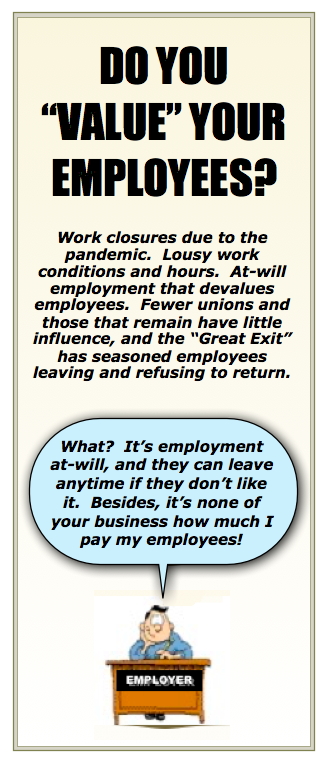
Employee compensation should
never be guesswork! |
|
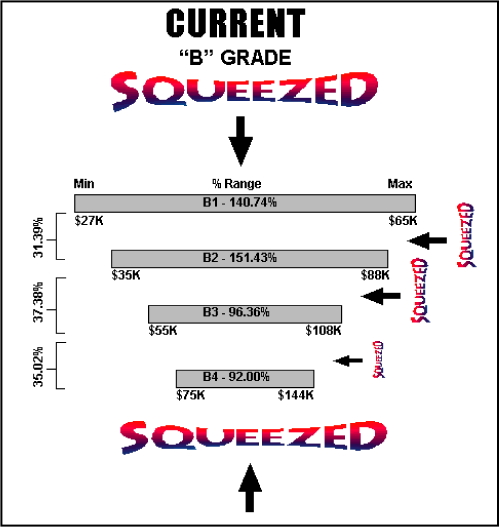
At left, an inequitably designed IT salary schedule.
To download PowerPoint Presentation, please click here.
|
|
At left, an equitably designed IT salary schedule.
To download PowerPoint Presentation, please click here.
|
At the City of Dallas:
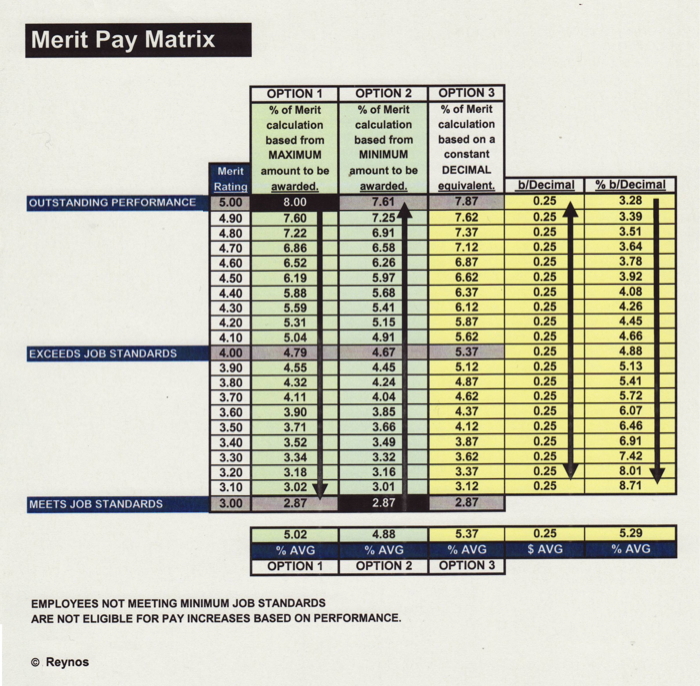
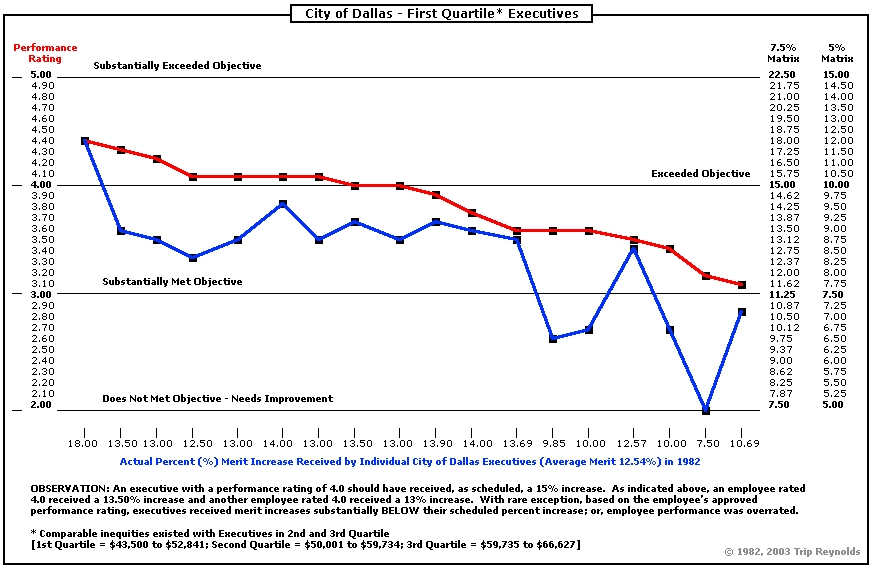
Across-the-board annual merit increases for department directors and senior staff did not reconciled with the established merit matrix. The overwhelming majority of department directors and senior managers were being over-rated or over-compensated, or under-rated and under-compensated. This inequitable practice was discontinued after I reported the graph below to my immediate management. If performance ratings reconciled with merit increases there would not be two-(2) separate lines below.
"...Enclosed in the
proposed personnel reorganization of Reunion Arena.
This is the result of many hours of working with the
Personnel Department over the last 8 months.
Individuals with the Personnel Department who have
assisted in this effort are Dr. Troy Coleman, Joe
Tillotson, Albert Chew, Bill Underhill, Melinda
Crayton, and especially Trip Reynolds." Will Caudell, General Manager, Reunion
Arena
At Denver Public Schools:
Specific example: At Denver Public Schools: Compensation of IT staff
was below market, with turnover of "critical need"
positions above accepted norms, which resulted in
expensive outsourcing. For example, high-end technical
programming was outsourced to vendors at $200,000 instead
of hiring staff at $90,000+ because: (a) the upper limit
for any IT position was less than $80,000; and (b)
despite the fact that market validated compensation of a
C++ programmer higher than a high school principal, it
was an unwritten DPS policy that absolutely no "staff"
position would be compensated higher than the maximum of
a high school principle. Additionally, all IT positions
were blended into one global salary schedule also shared
by non-IT positions that compressed IT compensation even
more.
What did I
deliver: Conceived, designed, proposed, and
implemented an original salary schedule dedicated for
IT positions, which contained an acceleration feature
indexed to market (this had not been done previously).
Plus, the new IT schedule contained an aggressive
pay-for-performance component (also new). Notably, a
dedicated IT salary schedule could have been created
back in late 1970s but, unfortunately, neither senior
management in HR or in the IT department had any
knowledge of President Carter's wage and price control
guidelines [due to the oil embargo/inflation]
from the 1970s, which capped salaries on all
industries except IT and engineering. Appropriately,
in 1999, I used my knowledge of the volatile nature of
IT compensation from the late 1970s to guide senior
management and staffs in the design, scope, and
implementation of an updated strategy for compensating
IT staff.
| |
Action Taken - I researched the entire scope of all IT positions,
both those based in the IT Department and those based
in schools and other operating departments. Next, I
submitted a position paper to senior management with
constructive and critical analysis on the future of IT
compensation, including budgetary impact, market
analysis, and position equity. During executive
management meetings on this issue I presented my
analysis and actively pursued motivating management to
adopt an original compensation strategy for IT
positions, which I conceived and designed. |
| |
|
| |
Outcome - Initially, the unwritten DPS policy that prohibited
any "staff" position from being compensated higher
than the maximum of a high school principle was a
roadblock to creating a robust, very competitive IT
salary schedule. However, I consistently provided the
executive management team and the Board of Education
with objective data on how this political roadblock
compromised internal and external position equity.
Consequently, by the end of year two of
implementation, this roadblock was eliminated by the
Board of Education, and I expanded the schedule
maximum to over $105,000. In summary, with few
exceptions, expensive outsourcing of IT work was
eliminated, and employee turnover in IT positions
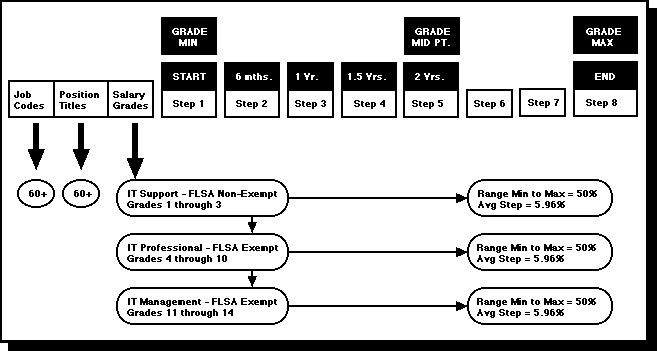
became negligible. An overview of the salary schedule
is presented below. To review/download the actual salary schedule, please click here. |
• Worked with Hay,
DeLoitte, A. Anderson and other major consulting firms
and, most importantly, routinely cleaned-up their
mistakes! Identified
deficiencies in the performance of HR consultants;
candidly and persuasively counseled senior
management.
• Consolidated forty-two (42) separate salary
schedules into one (1) salary schedule with no cost
impact.
• Conceived,
presented and facilitated an original proposal which was
approved by the DPS Board of Education for negotiation to
the classroom teachers bargaining unit which (1)
increased teacher pay, (2) placed teachers in a much more
competitive position in the market, (3) eliminated the
salary cap for 48% of employees who had reached their
salary grade ceilings, (4) had $0 cost of implementation,
and (5) upon agreement, saved the district more than $4.5
million dollars over a period of five years! [My
original proposal would have saved nearly $7.5
million.]. Also, designed a proprietary point-factor job evaluation system that for the first time, empowered one of the District's nine bargaining units to be 100% in complete control of the design, evaluation, and compensation of all membership positions [To review/download actual work product, see "Employee/Labor Relations" below].
Specific example: At Denver Public Schools: An outdated mainframe
housed an outdated HRIS, and other IT systems housed on
different platforms, were also compromised. Notably,
desktop PCs were also being used to store and process HR
data that exceeded the storage capacity of the
mainframes.
What did I
deliver: Wrote a critical but constructive
analysis that prompted senior management to complete
the implementation of a new HRIS (Lawson) which, over
two years prior to my hire, had been purchased for
several million dollars. Then, for the next six months
I lead the primary project team, guided senior
management and vendor representatives, and coordinated
and counseled staff and line management on the
configuration and implementation of the HRIS. After
six months the primary project team was split into
sub-teams, each with separate agendas under the
direction of multiple team leaders; I lead the
compensation team.
"It is a pleasure for me
to write a letter recommending Trip Reynolds. Mr.
Reynolds has an extensive knowledge of human resources
and continuously seeks to expand his knowledge and
problem solving/managerial skills. He has demonstrated
ability to clearly articulate complex issues and presents
information with confidence. Trip has analyzed the salary
structures of all employee groups, identified inequities,
and made recommendations for improving our "way of doing
business."
Irv Moskowitz, Superintendent, Denver Public
Schools
At National Jewish Center:
Specific example: An
outdated mainframe housed an outdated HRIS, and other IT
systems housed on different platforms, were also
compromised.
What did I
deliver: I performed as the "key" player in
guiding senior management in the design, scope,
implementation and training of management and staff on
the purchase and implementation of a new HRIS. I wrote
the request for information (RIF) and the request for
proposal (RFP), which included requirements for
integration with payroll and materials management, for
review by over 20 IT vendors; managed the on-site "dog
and pony" presentations of each vendor, performed as
the "point" NJC person for Q&A; conducted
independent testing of each HRIS product; produced a
final recommendation to the COO (JDEdwards); and was
the first manager/employee to be certified by the
vendor on the new HRIS. Subsequently, I trained senior
management and staff on overall system integration of
the new HRIS into existing manual and automated
workflow systems.
|
| |
|
|